

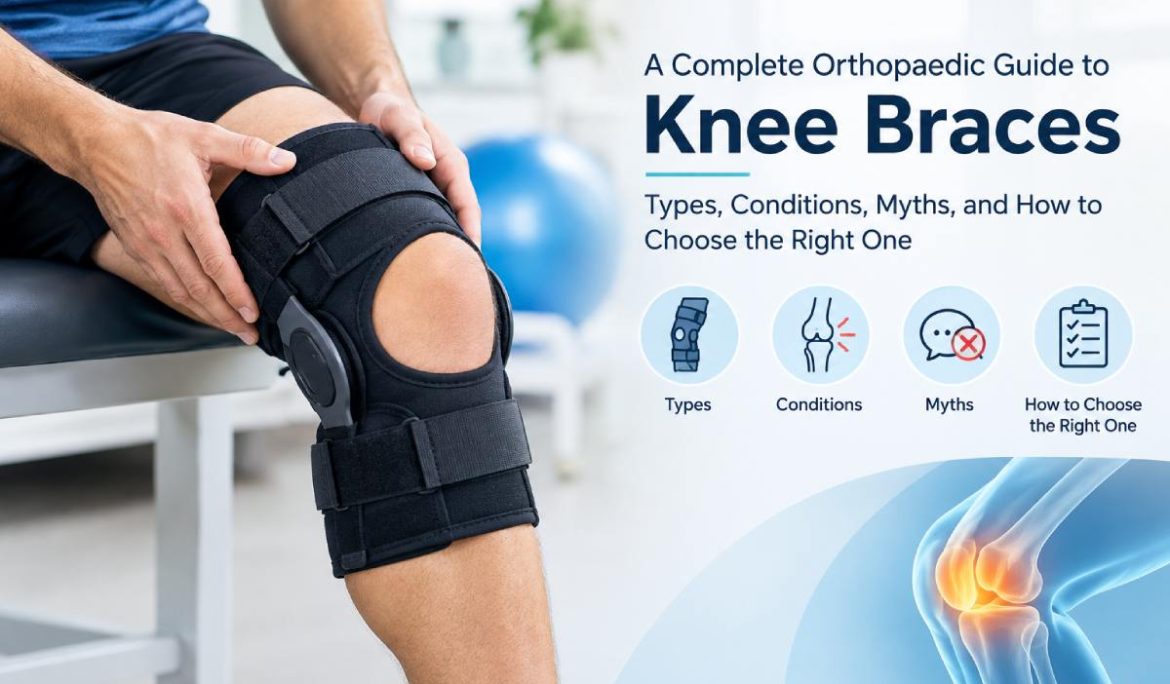
Is Your Knee Brace Actually Helping Your Knee?
Walk into any pharmacy or sports store in Thane or Mumbai, and you will find an entire rack of knee braces. Neoprene sleeves, hinged braces, unloader braces, patella straps, compression wraps dozens of options, no clear guidance, and usually no one qualified to explain which one (if any) you actually need.
Knee braces are one of the most commonly self-prescribed treatments in orthopaedics and one of the most commonly misused. Some people wear them indefinitely and become psychologically dependent on them. Others buy the wrong type and get no benefit. A few put them on over a significant injury and delay proper diagnosis for months.
Done correctly, the right brace for the right condition at the right time is a genuinely useful tool. It can reduce pain, improve function during sport, protect a healing ligament, slow arthritis progression, and give a patient the confidence to stay active. Done incorrectly, it is at best a waste of money and at worst a substitute for diagnosis and treatment.
This article explains what knee braces are, what the different types do, which conditions benefit from which brace, what the evidence actually says, and what the marketing does not tell you.
Understanding the Knee: Why It Sometimes Needs External Support
The knee is the largest joint in the human body. It is stabilised by four main ligaments (ACL, PCL, MCL, LCL), two menisci (cartilage cushions), the kneecap (patella) tracking system, and the surrounding muscles, particularly the quadriceps, hamstrings, and calf. A knee orthopedic near me can evaluate joint stability and recommend suitable support when needed.
A knee brace works by doing one or more of the following:
- Providing mechanical support to a damaged or weakened ligament
- Reducing the load on a specific compartment of the knee (medial or lateral)
- Compressing the joint to reduce swelling and improve proprioception (the knee’s positional sense)
- Restricting range of motion after surgery to protect healing tissue
- Redirecting the tracking of the kneecap to reduce pain
It is worth noting what a brace cannot do: it cannot repair a torn ligament, rebuild articular cartilage, increase bone density, or replace the function of strong, well-trained muscles. It is a tool to complement treatment, not a substitute for it.
Types of Knee Braces: What Each One Is Actually For
1. Prophylactic Braces (Injury Prevention)
These are designed to prevent knee injuries in contact sport, primarily to protect the MCL and ACL from valgus (knock-knee) forces during tackles and collisions. They are most commonly used in football, kabaddi, rugby, and wrestling.
The evidence for prophylactic braces is mixed. Some studies show modest reduction in MCL injury rates; the evidence for ACL prevention is weaker. Most sports medicine specialists agree that strength training, neuromuscular control programmes (such as FIFA 11+), and technique work are more effective injury prevention strategies than a brace alone.
- Available as: hinged metal or rigid polymer braces with medial and lateral uprights
- Best for: contact sport athletes with a history of ligament injury returning to collision sport
- Not recommended as a substitute for conditioning and technique work
2. Functional Braces (Post-Injury Stability)
Functional braces are designed to provide stability to a knee with a damaged ligament, most commonly after an ACL or PCL tear. An orthopedic knee brace for torn meniscus may provide support when selected for the specific injury. They control abnormal translation (sliding) of the tibia relative to the femur during activity.
For ACL-deficient knees in patients who are not pursuing surgical reconstruction (older adults, lower-demand individuals), a functional brace can allow continued activity with reduced instability. After ACL reconstruction, functional braces are sometimes used during the return-to-sport phase.
- Available as: rigid carbon fibre or lightweight polymer frames with hinges; custom-fitted or off-the-shelf
- Best for: ACL or PCL tears; post-reconstruction return to sport; avoiding surgery in select patients
- Key point: a functional brace reduces giving-way episodes but does not fully substitute for a functioning ACL; surgery is still the recommended treatment for young, active patients
3. Unloader (Offloader) Braces for Arthritis
These are one of the most evidence-backed brace types for a specific orthopaedic indication. They are designed for medial compartment osteoarthritis, the most common type, associated with bow-legged alignment where the inner side of the knee bears disproportionate load.
An unloader brace uses a three-point pressure system to shift the mechanical axis of the knee away from the arthritic compartment and onto the healthier side. In selected cases, hto knee surgery may be considered to correct alignment and reduce joint loading. This reduces pain and improves function in walking and light activity.
- Available as: custom-fitted (prescription) or off-the-shelf; typically rigid frame with lateral strap and pad
- Best for: Grade 2–3 medial knee arthritis with varus (bow-leg) alignment; delay of surgery; post-HTO period
- Evidence: Multiple RCTs confirm significant pain reduction and improved walking capacity compared to controls
- Limitation: bulky; less effective in very overweight patients; custom fitting improves outcomes
4. Rehabilitative Braces (Post-Surgery Control)
After ligament reconstruction, meniscal repair, or joint surgery, a rehabilitative brace controls range of motion during the healing phase. A rehabilitative knee brace can help protect healing tissues during controlled recovery. It allows the surgeon to set specific limits, for example, ‘0–90 degrees’ after an ACL repair, preventing the joint from moving into positions that could disrupt the repair.
- Hinged braces with adjustable range-of-motion settings. A rehabilitative knee brace allows controlled movement during early rehabilitation.
- Worn for 4-8 weeks post-surgery depending on the procedure
- Often replaced by a functional brace for the return-to-sport phase. A rehabilitative knee brace can support controlled recovery before progressing to sports activities.
5. Patellofemoral Braces (Kneecap Support)
These braces address problems with kneecap (patella) tracking. The patella normally glides in a central groove (trochlear groove) on the front of the femur. In patellofemoral pain syndrome, lateral tracking of the kneecap causes pain during squatting, stair-climbing, and running.
Patellofemoral braces use a ring, buttress, or strap around the kneecap to guide it back toward the centre of the groove. An orthopedic knee brace for torn meniscus is selected differently based on the location and severity of the tear. They are commonly combined with quadriceps strengthening (VMO exercises) for best results.
- Available as: patellar sleeves with lateral buttress; J-brace designs; patella tracking straps
- Best for: patellofemoral pain syndrome; mild patellar instability; runners’ knee
6. Knee Compression Sleeves
These are the most widely sold and most misused type. A compression sleeve provides warmth, mild proprioceptive feedback, and minimal compression. It does not provide meaningful ligament support. It is not a substitute for a functional or unloader brace.
Compression sleeves are appropriate for mild knee soreness during activity, mild swelling management, and as a psychological confidence tool during early return to exercise. They should not be worn as a long-term solution for significant knee pathology.
- Available as: neoprene, elastic, or knitted fabric sleeves
- Best for: mild generalised knee discomfort; light activity support; warmth and mild proprioception
- Not appropriate for: ligament instability, significant arthritis, post-surgery support, meniscal pathology
7. Patella Tendon Strap (Infrapatellar Strap)
A narrow strap worn just below the kneecap. It applies pressure to the patellar tendon, altering the angle at which the tendon pulls on the tibial tuberosity. Primarily used for patellar tendinopathy (‘jumper’s knee’) to reduce tendon pain during loading activity.
- Best for: patellar tendinopathy; tibial tubercle apophysitis (Osgood-Schlatter in adolescents)
- Used alongside eccentric loading physiotherapy for best results
Knee Brace Types: Quick Reference Guide
| Brace Type | Primary Use | Best Condition | Evidence Strength |
| Prophylactic | Injury prevention in contact sport | MCL risk in football, kabaddi | Moderate (MCL); Weak (ACL) |
| Functional (hinged) | Stability in ligament-deficient knee | ACL/PCL tear; post-reconstruction | Good |
| Unloader / Offloader | Redistribute load away from arthritic compartment | Medial knee OA with varus alignment | Strong |
| Rehabilitative | Protect healing tissue post-surgery | Post ACL / meniscal repair | Standard of care |
| Patellofemoral | Kneecap tracking and support | Patellofemoral pain, patellar instability | Moderate |
| Compression sleeve | Mild support, warmth, proprioception | Mild generalised knee soreness | Limited |
| Patellar tendon strap | Offload patellar tendon insertion | Patellar tendinopathy, Osgood-Schlatter | Moderate |
Knee Braces Available in India: What to Look For
Several reputable brands are available in Thane, Mumbai, and online across India. Patients searching for an orthopedic knee brace near me should consider professional fitting and guidance.
Here is a practical overview:
- DJO Global (DonJoy, Aircast)- considered the gold standard for functional and unloader braces globally; DonJoy Defiance and OA Adjuster 3 are among the most evidence-backed. Available through orthopaedic suppliers and online; more expensive but superior build quality.
- Bauerfeind (Germany)- excellent compression sleeves (GenuTrain series) and patellofemoral supports; well-researched and durable; GenuTrain knee support is one of the most studied sleeves for knee OA proprioception.
- Ossur- high-quality functional braces; Form Fit and Unloader One X series widely used for ACL instability and OA; available through orthopaedic distributors.
- Tynor (India)- one of the most widely available and affordable Indian brands; good range of patellofemoral supports, compression sleeves, and hinged braces; FSSAI/ISO-certified; suitable for budget-conscious patients.
- Vissco (India)- wide range of orthopaedic supports; decent quality for the price; widely available in pharmacies across Thane and Mumbai.
- Mueller Sports Medicine- popular patella straps and compression sleeves; affordable; widely available online.
- Thuasne (France)- high-quality patellofemoral and OA braces; available through specialised orthopaedic suppliers.
Important note: The best brace for your condition is the one prescribed or recommended by your orthopaedic surgeon after a proper assessment, not the most expensive one on Amazon or the one a gym trainer recommends. Consulting the best orthopedic surgeon near me can help determine whether a brace is appropriate.
Busting the Most Common Knee Brace Myths
There is a significant amount of misinformation about knee braces from gyms, social media, pharmacies, and well-meaning friends.
Here are the most important myths to correct:
| MYTH Wearing a knee brace will weaken your muscles over time. |
REALITY Short- to medium-term brace use (weeks to a few months) does not cause significant muscle atrophy. The clinical concern is with indefinite, full-time brace use replacing active rehabilitation. When braces are used alongside physiotherapy and strengthening exercises, they do not weaken the knee. |
| MYTH A knee brace can fully stabilise the knee after an ACL tear, making surgery unnecessary.. |
REALITY A functional brace reduces instability episodes but does not replace the mechanical function of the ACL. Young active patients who continue pivoting sport without surgery sustain progressive cartilage and meniscal damage with each instability episode. Surgery is the recommended treatment for most ACL-deficient active patients |
| MYTH Any compression sleeve will help an arthritic knee. |
REALITY Standard compression sleeves provide warmth and mild proprioceptive feedback but do not offload the arthritic compartment. Medial knee arthritis requires an unloader brace with a three-point pressure system specifically designed to shift the mechanical axis. Buying a pharmacy sleeve for moderate-to-severe arthritis provides minimal benefit. |
| MYTH
If you have knee pain, wearing a brace all day is safe and beneficial |
REALITY Continuous brace use can create skin problems (pressure sores, sweating, maceration), reduce proprioceptive retraining, and create psychological dependence. Most braces are prescribed for specific activities not all-day wear. Your surgeon or physio will advise the appropriate wearing schedule. |
| MYTH
The more expensive the brace, the better it is for your knee. |
REALITY Price reflects materials, build quality, and customisation, not necessarily clinical effectiveness for your specific condition. A correctly selected mid-range Indian brace (Tynor, Vissco) prescribed for the right indication outperforms an expensive brace bought for the wrong condition. Spend on the right type, not the most expensive type. |
| MYTH Wearing a knee brace will cure knee arthritis or heal a torn ligament. |
REALITY A brace manages symptoms and provides support; it does not repair damaged tissue. Arthritis does not reverse with a brace. A torn ACL does not regrow. A brace is a management tool, not a treatment that addresses structural damage. |
| Hazards and Precautions When Using Knee Braces
Skin irritation and pressure sores: Particularly with neoprene materials in Mumbai’s heat and humidity. Remove the brace periodically, wash and dry the skin, and choose breathable materials if wearing for extended periods. Circulation restriction: A brace worn too tightly can restrict venous return, increasing swelling below the brace or causing numbness. When choosing an orthopedic knee brace near me, proper sizing is essential for comfort and safety. The brace should be snug but not tight; you should be able to slide two fingers under the brace material. Masking underlying pathology: A brace that reduces pain during activity can cause a patient to continue placing load on a significantly damaged knee, worsening the underlying injury. Pain is a signal; a brace should not eliminate it completely and allow unrestricted activity without a proper diagnosis. Incorrect size: A brace that is too large migrates downward during activity, losing its function. A brace that is too small causes pressure sores and restricts circulation. Always measure the thigh circumference 15 cm above the knee and the calf circumference 15 cm below; use the manufacturer’s sizing charts. A properly fitted orthopedic knee brace near me option can improve comfort during activity. Psychological dependency: Some patients become unwilling to perform any activity without a brace, even after the underlying condition has resolved or been surgically treated. The goal of brace therapy is always to eventually return to unsupported function with adequate muscle strength. Physiotherapy alongside brace use prevents this dependency. |
Exercises That Complement Knee Brace Use
A brace works best as an adjunct to strengthening, not as a substitute for it. A knee specialist in Thane can help guide brace use alongside an appropriate rehabilitation plan.
These exercises build the muscular support that reduces your long-term dependence on external support:
1. Terminal Knee Extension (TKE)
Loop a resistance band around a fixed point at knee height. Stand facing the anchor, with the band behind the knee. Start with your knee bent 30 degrees, then straighten fully against the band. 3 sets of 15. Builds the VMO (inner quad), the most important muscle for knee stability.
2. Straight Leg Raise
Lying flat on your back, tighten the quad of the affected leg and raise it to 45 degrees. Hold for 2 seconds. Lower slowly. 3 sets of 15. Safe for most post-injury and post-surgery stages.
3. Clamshells
Lie on your side, knees bent to 45 degrees. Keeping feet together, raise the top knee like opening a clamshell. Hold 2 seconds. 3 sets of 15. Strengthens the hip abductors critical for healthy knee alignment and reducing valgus collapse.
4. Mini Squat to Box
Stand in front of a firm chair or box. Slowly lower yourself until you just touch the seat, then stand back up. Keep knees tracking over the second toe. 3 sets of 12. Builds functional quad strength in a safe range of motion.
5. Single Leg Balance
Stand on the affected leg with a slight knee bend. Hold for 30-60 seconds, progressively increasing difficulty by closing the eyes or standing on an unstable surface. Improves proprioception, the knee’s ability to sense position, which is impaired by ligament injury and arthritis.
Recovery: How Long Will You Need a Knee Brace?
| Condition | Typical Brace Duration | Notes |
| Mild knee sprain/contusion | 1-3 weeks | Compression sleeve; wean off as strength returns |
| Moderate ligament sprain | 4-6 weeks | Functional or hinged brace; concurrent physio |
| ACL tear (conservative management) | Indefinite during sport | Functional brace reduces giving-way; surgery preferred for active patients |
| Post ACL reconstruction | 6 weeks (rehabilitative) + 3–6 months (functional for sport) | Progressively reduce brace use as strength criteria met |
| Medial OA / arthritis | As needed for activity | Unloader brace for walking and sport; not for rest |
| Patellofemoral pain | 6-12 weeks alongside physio | Reduce use as VMO strengthening improves tracking |
| Post meniscal repair | 4-6 weeks (surgeon-directed) | Specific ROM limits set by surgeon |
An orthopedic knee brace for torn meniscus may be used with surgeon-directed rehabilitation.
Prevention: Keeping Your Knee Healthy and Reducing Brace Dependence
|
The Long-Term Knee Health Checklist 1. Strengthen your quadriceps and hamstrings consistently; they are the primary protectors of the knee joint 2. Maintain a healthy weight; every extra kilogram adds 4 kg of force across the knee 3. Warm up before sport and cool down after; dynamic warm-up reduces injury risk by up to 50% 4. Improve landing mechanics and cutting technique; most ACL tears are non-contact; technique matters 5. Use a brace as a transitional tool, not a permanent crutch. The goal is always to return to unsupported activity 6. Treat knee injuries properly; the first time incomplete rehabilitation leads to re-injury and dependence on support 7. Get a specialist opinion before buying a brace; the right brace for the wrong condition provides no benefit. Those seeking the best orthopedic surgeon near me should prioritise proper knee assessment before choosing a brace. 8. If you have knee arthritis, ask your surgeon about HTO (high tibial osteotomy) or orthobiologics; both can reduce pain better than a brace alone in appropriate patients. HTO knee surgery may be an option for suitable patients with specific knee alignment problems. |
When Should You See an Orthopaedic Surgeon About Your Knee?
Searching for a knee orthopedic near me can help you arrange an appropriate clinical evaluation.
Seek specialist review before buying a brace if:
- The knee swelled rapidly after an injury; this needs imaging, not just a brace
- The knee gives way, locks, or produces a painful click; structural damage needs diagnosis. A knee orthopedic near me can assess symptoms that may indicate ligament or meniscal damage.
- You have been using a compression sleeve for more than 4-6 weeks without improvement. A knee specialist near me can assess persistent symptoms and suggest suitable care.
- You want to return to competitive sport after a knee injury
- Knee pain is waking you at night or preventing normal daily activities
- You are over 50 with knee pain and a bowing of the legs; unloader brace assessment may be relevant
The best orthopedic surgeon near me can assess whether specialist treatment or bracing is appropriate. Orthopaedic surgeons in Thane, Navi Mumbai, and Mumbai can assess your knee clinically, arrange appropriate imaging, and prescribe the specific brace type or confirm that no brace is needed and physiotherapy alone is sufficient.
For personalised guidance on knee conditions, treatment options, and recovery, contact our team for professional assistance. Connect with an experienced orthopedic surgeon in Thane for specialist evaluation and personalised knee care.
Frequently Asked Questions (FAQ)
Do I need a prescription to buy a knee brace in India?
Basic compression sleeves and patella straps are available over the counter without a prescription at pharmacies and sports stores across Thane and Mumbai. However, functional braces, unloader braces, and rehabilitative braces are significantly more effective when selected by an orthopaedic surgeon or physiotherapist after a proper assessment. Buying a brace without knowing your diagnosis is a common and potentially harmful approach.
Can I wear a knee brace while playing cricket, football, or badminton?
Yes, and many athletes do. The appropriate brace depends on your knee condition. For an ACL-deficient knee, a functional hinged brace is recommended. For general knee discomfort during sport, a compression sleeve may suffice. For patellofemoral pain, a patellar tracking sleeve helps. The brace should allow the specific movements your sport requires while providing the targeted support you need. Your surgeon will advise on which type is compatible with your sport.
How do I know if my knee brace is the right size?
Measure the circumference of your thigh 15 cm above the knee centre, and the calf 15 cm below. Use the manufacturer’s specific sizing chart; sizing varies significantly between brands. The brace should be snug enough to stay in place during activity without migrating down, but loose enough to slide two fingers underneath. A brace that slides, bunches, or causes numbness or skin marks is incorrectly sized.
Is a neoprene knee sleeve the same as an unloader brace?
No, they are fundamentally different devices. A neoprene sleeve provides compression and warmth but no meaningful mechanical support. An unloader brace is a rigid, hinged device that uses a three-point pressure system to shift the mechanical axis of the knee away from the arthritic compartment. For medial knee arthritis, only the unloader brace has demonstrated clinical evidence for pain reduction and improved function. A sleeve worn for arthritis is largely a comfort measure.
Will wearing a knee brace slow down muscle wasting?
No, muscle strengthening exercises slow muscle wasting, not braces. A brace worn without concurrent quadriceps and hamstring strengthening may actually delay functional recovery by creating dependence on external support. The best approach is to use the brace for activity support while simultaneously doing the physiotherapy exercises that rebuild the muscle bulk that will eventually allow you to reduce brace dependence.
My doctor says I need an ACL operation, but I feel fine with a brace. Can I just use a brace forever?
This is one of the most important questions patients ask. A functional brace reduces the feeling of instability and allows lower-demand activity. However, it does not prevent the progressive cartilage and meniscal damage that occurs with each giving-way episode in an ACL-deficient knee. Studies show that patients who delay or avoid ACL surgery and return to pivoting sport have significantly higher rates of medial and lateral cartilage damage over 5–10 years, leading to earlier arthritis. For young active patients in Thane and Mumbai who want to play sport, surgery followed by proper rehabilitation remains the recommended path.
Can a knee brace help with sciatica or back pain that radiates into the leg?
No. A knee brace addresses mechanical knee pathology. Sciatica is nerve pain originating from the lumbar spine that radiates into the leg and has nothing to do with the knee joint. A knee brace has no effect on sciatic nerve compression. If you have leg pain that travels from the back or buttock into the knee or below, you need a spine assessment, not a knee brace.
Are there knee braces specifically for elderly patients with arthritis?
Yes. The unloader brace is the most evidence-based option for medial compartment osteoarthritis. For elderly patients with generalised knee stiffness and mild OA who are not candidates for an unloader brace, a Bauerfeind GenuTrain-type compression sleeve can improve proprioception and reduce pain during walking. For patients with significant arthritis and difficulty with complex braces, a simple neoprene sleeve worn during activity may improve comfort even if it does not offload the joint.
References and Further Reading
The following peer-reviewed sources underpin the clinical recommendations in this article:
- Hamill J, et al. (2019). Biomechanical basis of knee brace function. British Journal of Sports Medicine, 53(7), 412–419.
- Ramsey DK, et al. (2003). The influence of prophylactic knee bracing on lower extremity joint position and muscle EMG activation during a cutting manoeuvre. Clinical Biomechanics, 18(5), 394–401.
- Brouwer RW, et al. (2007). Braces and orthoses for treating osteoarthritis of the knee. Cochrane Database of Systematic Reviews, Issue 1. Art. No.: CD004020.
- Mistry DA, et al. (2018). A systematic review of the effectiveness of knee braces for the treatment of knee osteoarthritis. BMJ Open, 8(6), e019766.
- Narahari S, et al. (2021). Functional knee bracing in ACL-deficient knees — a systematic review. Knee Surgery, Sports Traumatology, Arthroscopy, 29(3), 844–856.
- Raja K, et al. (2011). Effectiveness of knee braces in the Indian population: a prospective cohort study. Journal of Orthopaedic Surgery, 19(2), 184–188.
- DonJoy Clinical Evidence Compendium, 2022. Enovis Corporation.
- Bauerfeind GenuTrain Clinical Studies Compendium, 2021. Bauerfeind AG.
- Bleakley CM, et al. (2012). PRICE needs updating, should we call the POLICE? British Journal of Sports Medicine, 46(4), 220–221.
- ICMR Guidelines for Osteoarthritis Management in the Indian Population, 2020.
| A Note from Our Practice
A knee brace is not a diagnosis. It is not a treatment. It is a tool and like any tool, it is only useful when chosen correctly for the job at hand. If you have been living with knee pain, instability, or arthritis and relying on a brace that does not seem to be making things better, the right next step is a specialist assessment, not a different brace. Understanding exactly what is happening in your knee will tell you whether a brace is the right tool, which type, and whether other treatment is needed alongside it. Book a consultation today, and get a knee assessment that goes beyond what any brace can provide. |
This article is written for educational purposes and does not replace personalised medical advice. Please consult a qualified orthopaedic surgeon for diagnosis and treatment specific to your condition.