

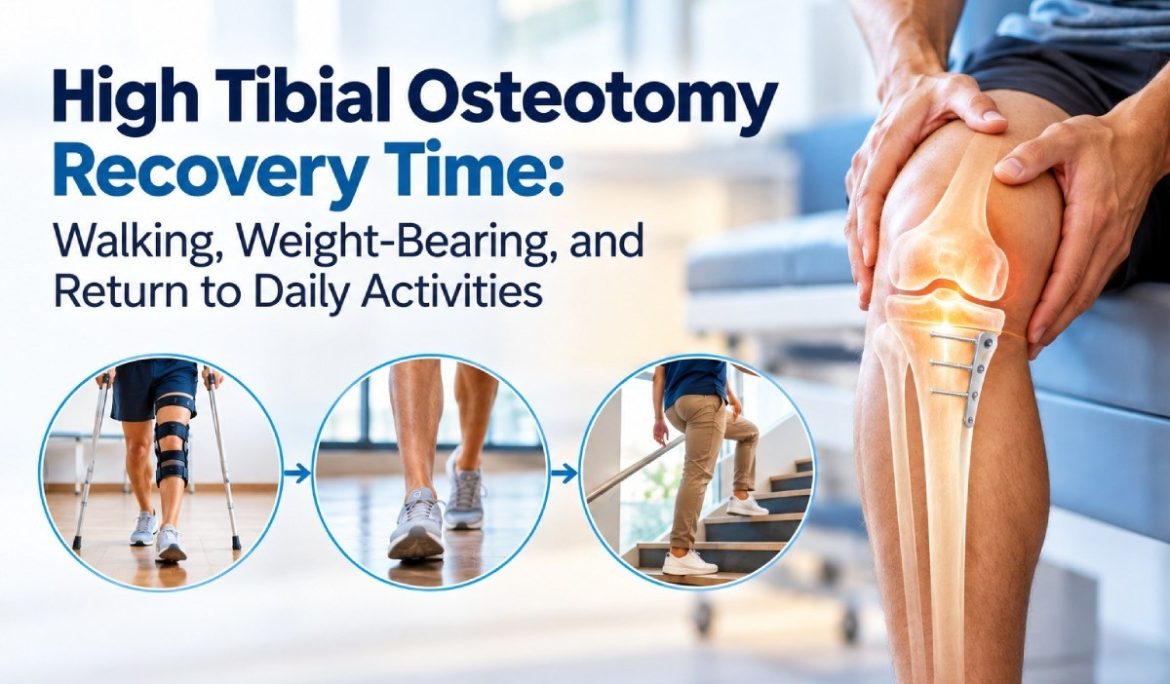
Recovering from high tibial osteotomy (HTO) involves more than waiting for knee pain to improve. The procedure changes the alignment of the upper shinbone to redistribute pressure across the knee, which means the bone needs time to heal while movement, muscle strength, and walking ability are gradually restored.
One of the most common questions patients ask before surgery is: How long does high tibial osteotomy recovery take? Understanding the expected high tibial osteotomy recovery time helps patients prepare for rehabilitation, plan their return to work, and set realistic expectations for daily activities.
The answer depends on the surgical technique, fixation method, bone healing, whether other procedures are performed at the same time, and the rehabilitation plan prescribed by the surgeon. Some patients may begin carefully supported walking soon after surgery, while others need a longer period of restricted weight-bearing.
Dr. Tushar Kadam’s published HTO treatment information describes an initial period of limited weight-bearing, the use of a walker or crutches, early knee movement exercises, and physiotherapy. It notes that many patients resume normal activities within approximately four to six months, although individual recovery can vary.
This guide explains the HTO recovery timeline, when walking may become easier, how weight-bearing restrictions work, what happens during rehabilitation and when patients may be able to return to work and everyday activities.
Important: The timelines below are general educational guidance, not an individual rehabilitation prescription. Your operating surgeon’s instructions take priority, particularly for weight-bearing, knee movement, wound care, and exercise progression.
How Long Does High Tibial Osteotomy Recovery Take?
The high tibial osteotomy recovery time usually spans several months rather than following one fixed deadline.
- First few days: Pain management, wound care, safe transfers, supported walking as permitted, and initial knee exercises.
- First two weeks: Wound review, swelling management, continued use of walking aids and gradual improvement in movement.
- Weeks 2-6: Progressive rehabilitation, muscle activation and weight-bearing according to the surgical protocol.
- Weeks 6-12: Some patients progress towards fuller weight-bearing, improved walking and greater independence, subject to clinical review and bone healing.
- Months 3-4: Strength, endurance and everyday function may continue to improve. Some patients may begin a more substantial return to routine activities.
- Months 4-6 and beyond: Many patients continue building strength and activity tolerance. Higher-impact activities may require longer and should only resume with appropriate clearance.
These are broad phases, not guaranteed milestones. Weight-bearing may be advanced earlier or later depending on fixation stability, the osteotomy performed, associated procedures, and follow-up findings. The most important principle is that walking comfortably, putting full weight through the leg, bone union, and returning to demanding activity are four different recovery milestones.
What Is High Tibial Osteotomy?
High tibial osteotomy, commonly called HTO, is an orthopaedic procedure that changes the alignment of the upper tibia, or shinbone, just below the knee. It is used in selected patients whose knee alignment causes excessive pressure on a particular part of the joint. For example, some patients with bow-legged alignment and arthritis affecting the inner compartment of the knee may be considered for this procedure.
By adjusting the alignment, the surgeon aims to redistribute the forces passing through the knee. This may reduce pressure on the affected area, improve symptoms, and help preserve the natural joint in appropriately selected patients. HTO may be performed as an opening-wedge or closing-wedge osteotomy. The choice depends on the patient’s anatomy, alignment, joint condition, and surgical plan.
The bone is stabilised with appropriate fixation, commonly a plate and screws. Following surgery, the bone must heal in its corrected position. This is why high tibial osteotomy recovery differs from recovery after a simple soft-tissue injury. The rehabilitation plan must account for both the knee joint and the healing bone. Patients can read more about the procedure on the High Tibial Osteotomy treatment page.
High Tibial Osteotomy Recovery Timeline
The HTO recovery timeline explains what patients may experience during different stages of recovery, from initial mobility and weight-bearing restrictions to rehabilitation and returning to daily activities. Actual milestones must be adjusted to the individual surgical plan and clinical progress.
Phase 1: The First Few Days After HTO Surgery
The initial recovery phase focuses on pain control, wound protection, safe movement, and preventing avoidable complications. Patients are monitored after surgery, and the care team assesses pain, swelling, circulation, sensation, and the ability to move safely.
A physiotherapist may help the patient get out of bed, transfer to a chair, and begin walking with an appropriate aid. The amount of weight permitted through the operated leg depends on the surgeon’s instructions. Walking after HTO surgery does not necessarily mean full weight-bearing is allowed. A patient may be able to stand or walk a short distance with crutches while still needing to protect the operated leg.
Early rehabilitation may include:
- Gentle knee movement within the permitted range.
- Quadriceps activation exercises.
- Ankle movements to encourage circulation.
- Safe transfers between the bed and chair.
- Walking-aid training.
- Instruction on stairs, if required for discharge.
- Guidance on elevating the leg and managing swelling.
The exercises and movement limits should be demonstrated by the treating team. Patients should not independently increase exercise intensity because the knee feels comfortable.
When can patients go home?
Hospital discharge depends on pain control, general health, safe mobility, wound status, and whether the patient can manage the prescribed restrictions. Before going home, patients should understand how to use their walking aids, follow the weight-bearing plan, manage the wound, and perform their prescribed exercises. They should also know whom to contact if pain increases, the wound changes, or another concern develops.
Phase 2: The First Two Weeks
During the first two weeks, pain and swelling may gradually improve, but the operated knee can remain stiff and sensitive. The priorities are protecting the surgical site, following weight-bearing restrictions, and beginning rehabilitation without placing excessive stress on the healing bone.
Walking during the first two weeks
Walking may be limited to short, necessary distances using the prescribed walker or crutches. The patient may need to place only a small amount of weight through the operated leg, or avoid weight-bearing entirely, depending on the protocol. Do not stop using crutches simply because pain has reduced. Pain relief does not confirm that the osteotomy has healed sufficiently to tolerate more load.
Wound care
- Follow the surgical team’s instructions about dressings, bathing, wound inspection and stitch or staple removal.
- Keep the wound protected as directed. Do not apply unapproved creams, powders or home remedies to the incision.
- Seek medical advice if the wound becomes increasingly red, hot, swollen or painful, or if there is discharge or fever.
Managing swelling
Swelling can increase after activity. The care team may recommend elevation, cold therapy with suitable skin protection and prescribed pain relief. Avoid placing ice directly on the skin. Follow the clinician’s advice about the duration and frequency of cold application. A useful approach is to divide activity into manageable periods rather than spending long periods standing or walking.
Phase 3: Weeks 2-6 – Protecting the Bone While Restoring Movement
This stage is often a major part of the high tibial osteotomy recovery time because patients must balance restoring knee movement with protecting the healing osteotomy. The exact plan varies considerably between patients.
Some fixation constructs and surgical protocols permit earlier progression of weight-bearing. Others require a longer period of partial or restricted weight-bearing. For this reason, there is no single weight-bearing schedule that is safe for every person after HTO.
Why is weight-bearing restricted?
The osteotomy creates a controlled change in the bone’s structure. The fixation holds the corrected position while healing occurs. Excessive loading before the bone and fixation can tolerate it may interfere with healing or jeopardise the correction. The surgeon therefore determines when and how weight-bearing should progress.
Can the knee be bent during this phase?
Often, gentle range-of-motion exercises begin early, but the permitted range depends on the operation and whether additional procedures were performed. A patient who undergoes HTO alongside meniscus repair, cartilage treatment or ligament reconstruction may have different restrictions from someone who has undergone an isolated osteotomy. Do not copy another patient’s exercise programme or bend the knee beyond the prescribed limit.
What about muscle weakness?
Quadriceps weakness is common after knee surgery because pain, swelling and reduced activity affect muscle activation. Rehabilitation may include prescribed quadriceps contractions, straight-leg raises when appropriate, gentle knee movement and other exercises selected by the physiotherapist. The aim is to maintain muscle function while respecting the healing bone and any movement restrictions.
Phase 4: Weeks 6-12 – Progressing Towards More Independent Walking
For many patients, this phase involves reassessment and possible progression towards fuller weight-bearing. However, the timing should be based on clinical review, the surgical technique and evidence of bone healing rather than the calendar alone. The surgeon may assess pain, swelling, knee movement, stability and follow-up imaging before changing restrictions.
If progress is satisfactory, the physiotherapy plan may gradually introduce:
- Increased walking within the permitted limits.
- Improved knee extension and flexion.
- Progressive strengthening.
- Gait retraining.
- Balance exercises when appropriate.
- More independent daily activities.
When can crutches be stopped?
Crutches should be reduced only when the treating surgeon or physiotherapist considers it safe. The patient should be able to walk with appropriate control and without excessive limping, while meeting the weight-bearing requirements.
Stopping walking aids too early can encourage an abnormal walking pattern and place more stress on the operated leg than intended. Some patients progress faster than others. Additional procedures, slower bone healing, persistent swelling or muscle weakness may delay this stage.
Phase 5: Months 3-4 – Building Strength and Everyday Function
By this stage, many patients are working towards improved walking tolerance, strength and confidence during daily activities. The emphasis shifts gradually from basic mobility to better control and endurance. Depending on recovery, rehabilitation may progress to more challenging strengthening, balance and functional exercises.
Examples may include sit-to-stand practice, controlled step exercises and stationary cycling when approved by the rehabilitation team. Not every exercise is suitable for every patient. The programme should reflect knee movement, bone healing, muscle strength and any additional surgical procedures.
Does less pain mean the bone has healed?
No. Pain is only one part of the recovery assessment. A patient may feel better before the bone has fully united. Conversely, some discomfort or stiffness may persist even while healing progresses appropriately. The surgeon combines the clinical examination with imaging and other findings to determine whether the bone is healing as expected.
Phase 6: Months 4-6 and Beyond – Returning to Normal Activities
Many patients continue to make meaningful progress during this stage, although the pace varies. Walking, household tasks and other routine activities may become easier as strength and endurance improve.
Some patients may be ready for more demanding activities, while others still need additional rehabilitation. The decision to resume higher-impact exercise, running, jumping or sport requires particular care because these activities place greater loads on the knee.
Return to activity should depend on:
- Bone healing and follow-up findings.
- Pain and swelling.
- Knee range of motion.
- Muscle strength.
- Balance and movement control.
- The demands of the activity.
- The surgeon’s and physiotherapist’s assessment.
Full recovery may continue beyond six months. Do not assume that every patient is ready for unrestricted sport or heavy physical work at the same time.
Weight Bearing After HTO: What Do the Restrictions Mean?
Understanding weight bearing after HTO is one of the most important aspects of recovery. It describes how much weight or force the patient is permitted to place through the operated leg when standing or walking. The treating team may prescribe one of several approaches.
Non-weight-bearing
The patient must avoid placing weight through the operated leg while moving. Walking aids are used to support mobility.
Partial weight-bearing
Only a specified amount of weight is permitted through the operated leg. Crutches or a walker help control loading.
Weight-bearing as tolerated
The patient may place weight through the leg within the limits specified by the treating team, guided by comfort and safe movement.
Full weight-bearing
The patient is permitted to place their full body weight through the operated leg, subject to the prescribed activity restrictions.
These categories are not interchangeable. Patients should ask their surgical team to explain exactly what their instructions mean in practical terms.
Why do HTO weight-bearing protocols differ?
The permitted weight bearing after HTO depends on several factors:
- Whether an opening-wedge or closing-wedge procedure was performed.
- The stability of the fixation.
- The size and location of the osteotomy.
- Whether there are concerns about the bone hinge or other aspects of the procedure.
- Whether meniscus, cartilage, or ligament procedures were performed at the same time.
- The patient’s bone quality and other clinical factors.
- The surgeon’s rehabilitation protocol.
Published research describes different weight-bearing protocols following HTO, including earlier progression with some stable locking-plate constructs and more restrictive protocols in other circumstances.
This reinforces the importance of following the individual surgical plan rather than adopting a universal schedule. Never increase weight-bearing simply because another patient started walking without crutches earlier.
Walking After HTO Surgery: How to Progress Safely
Walking is an important part of rehabilitation, but it should progress gradually.
Start with the prescribed walking aid
Use the walker or crutches recommended by the physiotherapist. Ensure that the aid is correctly adjusted and that you know how to move without placing excessive weight on the operated leg.
Keep walking distances manageable
Short, planned walks may be more appropriate than attempting to cover a long distance in one session. If activity causes a marked increase in pain or swelling, discuss the response with your treating team and adjust activity according to their guidance.
Focus on walking quality
Walking with a pronounced limp, losing balance, or compensating with the other leg can indicate that the current activity level exceeds your ability. The physiotherapist can assess your gait and advise whether you should continue using the walking aid.
Progress only after review
Do not independently move from partial to full weight-bearing. Your surgeon may need to assess the bone’s healing and the stability of the correction before allowing progression.
Manage stairs carefully
Stairs require more strength, balance and control than level walking. Learn the recommended technique from your physiotherapist before attempting stairs independently. If your home has steps, discuss this before discharge and arrange support if necessary.
Physiotherapy After High Tibial Osteotomy
Physiotherapy helps restore movement, muscle strength, walking mechanics and functional ability after surgery. The programme should be adapted to the operation performed and the patient’s recovery.
Early movement and muscle activation
Initial exercises may focus on maintaining circulation, activating the quadriceps and restoring permitted knee movement. The aim is to reduce avoidable stiffness and muscle loss without overloading the healing bone.
Restoring range of motion
Knee extension and flexion are important for walking, sitting and climbing stairs. The physiotherapist will guide movement within the range allowed by the surgeon. Progress should be gradual rather than forced.
Strengthening
As healing progresses, exercises may target the quadriceps, hamstrings, hip muscles, and other structures that support the leg. Strengthening helps improve control and reduces the tendency to compensate with the other leg.
Gait and balance training
Patients may need to relearn a more normal walking pattern after a period of restricted weight-bearing. The rehabilitation team can work on step length, balance, safe transfers and gradually increasing walking tolerance.
Functional training
Later rehabilitation may include activities related to the patient’s daily needs, such as standing from a chair, managing stairs, and walking for longer periods. More demanding exercises should be introduced only when the clinical team considers them appropriate.
Follow-Up Appointments and X-Rays: Why They Matter
Follow-up visits are an essential part of HTO recovery. The surgeon needs to assess more than whether pain has improved. The review may include the wound, swelling, knee movement, function, alignment, and signs of bone healing.
X-rays may be used to evaluate the osteotomy, fixation, and progression of bone union. Depending on the case, imaging may also help assess whether the corrected alignment is being maintained. The timing of follow-up imaging varies according to the surgical protocol and the patient’s progress.
Why should weight-bearing not be increased without review?
A patient may feel ready to walk more, but the surgeon needs to establish whether the bone can tolerate the additional load. Follow-up findings help determine when it is appropriate to progress weight-bearing, reduce walking aids, or advance rehabilitation. Attend the scheduled appointments even when recovery appears to be going well.
When Can You Return to Work After HTO?
Return to work depends on the type of work, recovery progress, transport requirements, and the ability to follow restrictions safely.
Desk-based work
People with sedentary jobs may be able to return earlier than those whose work involves prolonged standing or physical activity. However, commuting, using stairs, sitting for long periods and keeping the leg elevated may affect the practical decision. A phased return, flexible hours or temporary work-from-home arrangements may help some patients.
Jobs involving standing or walking
Occupations that require prolonged standing, frequent walking, or moving around may require a longer recovery period. The patient should be able to manage these demands without compromising the rehabilitation plan.
Heavy manual work
Jobs involving lifting, carrying, squatting, climbing, or heavy physical effort generally require more recovery and functional preparation. Return should be discussed with the surgeon, especially if the job places significant loads on the knee. There is no single return-to-work date that applies to every HTO patient.
When Can You Drive After HTO Surgery?
Driving depends on the operated leg, pain, muscle control, walking aids, medication, and the ability to react safely. Before returning to driving, you should be able to control the vehicle and perform an emergency stop safely. You should also follow the surgeon’s advice and any applicable legal and insurance requirements.
Do not drive while taking medication that impairs alertness or reaction time. If your right leg has been operated on, the ability to operate the accelerator and brake may be particularly relevant. An automatic vehicle does not automatically make driving safe. Ask your surgeon when driving can be reconsidered rather than relying on a fixed number of weeks.
When Can You Exercise or Return to Sports?
Returning to exercise is not the same as returning to competitive sport. Low-impact activities may be introduced gradually during rehabilitation, depending on bone healing, knee movement and the surgeon’s advice. Running, jumping, pivoting and contact sports place greater loads on the knee and require more demanding strength and movement control.
Before returning to sport, the rehabilitation team may assess:
- Strength compared with the other leg.
- Knee movement.
- Balance and control.
- Walking and running mechanics.
- Swelling after exercise.
- Tolerance of progressive functional tasks.
- Imaging and clinical evidence of healing.
A patient should not return to high-impact activity simply because everyday walking has improved.
The timing depends on the operation, associated procedures, and individual progress. Return-to-sport research after HTO shows that many patients resume sporting activity, but timelines and levels of return vary. A systematic review found that most patients who returned to work or sport did so within a year; this is a broad research finding, not a personal recovery deadline.
What Factors Affect HTO Surgery Recovery Time?
Several factors can influence the high tibial osteotomy recovery time and the quality of recovery.
Surgical technique and fixation
The type of osteotomy and the stability of fixation influence the rehabilitation plan and the amount of weight-bearing permitted.
Additional procedures
Patients who undergo HTO alongside meniscus repair, cartilage treatment or ligament reconstruction may have additional restrictions.
Bone healing
The osteotomy needs to unite adequately. Delayed healing can affect the progression of walking, strengthening and demanding activities.
Muscle strength before surgery
Patients who begin surgery with significant weakness or reduced mobility may require more rehabilitation to restore function.
General health and bone health
Medical conditions, bone quality, smoking and other factors can affect healing. Discuss relevant medical history and medication with the treating team.
Rehabilitation consistency
Following the prescribed programme helps restore movement and strength. However, doing more exercise than advised is not necessarily better and may create unnecessary stress.
Home and work demands
A patient who needs to climb stairs, travel long distances or return to a physically demanding job may need additional planning and support.
How Can You Prepare for a Smoother Recovery?
Preparation begins before surgery.
Organise your home
Keep essential items within easy reach, reduce trip hazards and arrange a suitable place to rest with the operated leg supported as instructed. If you have stairs at home, discuss how to manage them safely with your physiotherapist.
Arrange assistance
You may need help with shopping, cooking, transport and other daily tasks during the early recovery period. Support plan rather than assuming you will be able to manage everything independently.
Learn to use walking aids
If possible, learn the correct technique before surgery. Understanding how to use crutches or a walker can make early mobility safer.
Follow medication instructions
Discuss your current medication, pain management plan, and any medicines that need adjustment around surgery with the treating team. Do not start or stop medication independently.
Keep follow-up appointments
Understand the expected review schedule and whom to contact if you have concerns between appointments.
Set realistic expectations
Recovery may involve gradual progress, occasional setbacks, and adjustments to rehabilitation. The objective is safe healing and improved function, not reaching a particular milestone on a predetermined date.
What Are the Warning Signs During HTO Recovery?
Some pain, swelling, and stiffness may occur after surgery, but certain symptoms require prompt medical attention.
Contact your surgical team urgently if you experience:
- Increasing pain that is not improving as expected.
- Worsening redness, warmth or discharge from the wound.
- Fever or feeling significantly unwell.
- Sudden deterioration in knee movement or ability to use the leg.
- New numbness, weakness or changes in foot colour or temperature.
Seek emergency medical attention for sudden shortness of breath, chest pain, fainting or other symptoms that could indicate a serious complication. New calf pain or swelling also requires prompt medical assessment because a blood clot is one possible cause. Do not wait for a routine follow-up appointment if you develop concerning symptoms.
What Happens If the Bone Takes Longer to Heal?
Bone healing does not progress at the same rate in every patient. If healing is slower than expected, the surgeon may review symptoms, imaging, fixation, and relevant medical factors. The rehabilitation plan may need to be adjusted, including restrictions on weight-bearing or exercise.
Delayed healing does not automatically mean that the operation has failed. It does mean that the cause and the appropriate next steps need to be assessed. Patients should not try to accelerate healing by increasing exercise, changing medication, or using supplements without appropriate medical advice.
HTO Recovery vs Knee Replacement Recovery
High tibial osteotomy and knee replacement are different operations, so their recovery pathways are not directly interchangeable. HTO changes the alignment of the tibia while preserving the natural knee joint. Recovery must account for healing at the osteotomy site.
Knee replacement involves replacing damaged joint surfaces with artificial components. Its rehabilitation programme has different priorities and restrictions. Both procedures require pain management, movement, strengthening, and follow-up, but the timing of weight-bearing and activity progression depends on the operation performed.
The appropriate procedure depends on the patient’s diagnosis, alignment, joint damage, activity goals, and overall health. Recovery expectations should be discussed before surgery rather than comparing procedures using a single timeline. For more information, read about knee replacement surgery.
Can Non-Surgical Treatment Help Avoid or Delay Surgery?
Not every patient with knee arthritis or alignment-related pain needs an operation immediately. Depending on the diagnosis, symptoms, and degree of structural damage, non-surgical management may include appropriate exercise, physiotherapy, activity modification, weight management where relevant, and medication when clinically suitable.
These options may help some patients manage symptoms and function. However, non-surgical treatment cannot correct every structural alignment problem. If surgery has been recommended, ask the treating surgeon why it is being considered, what alternatives are available, and what may happen if treatment is delayed. Learn more about the available non-surgical orthopaedic treatment options.
Frequently Asked Questions About High Tibial Osteotomy Recovery
1. How long does high tibial osteotomy recovery take?
The high tibial osteotomy recovery time usually spans several months. Many patients work towards returning to routine activities within approximately four to six months, but full recovery can take longer depending on bone healing, the surgical technique, associated procedures, and rehabilitation.
2. How long does HTO surgery recovery time take before walking?
Patients may begin supported walking soon after surgery if permitted by the surgeon and physiotherapist. However, early walking may involve restricted weight-bearing and the use of crutches or a walker. Walking independently takes longer and depends on healing and strength.
3. When can I put full weight on my leg after HTO?
The timing varies by surgical technique, fixation stability, bone healing, and associated procedures. Some protocols permit earlier progression, while others require several weeks of restricted weight-bearing. Follow the specific instructions given by your surgeon.
4. Is walking after HTO surgery painful?
Some discomfort and swelling are common during early recovery. Pain management, walking aids, and gradual rehabilitation can help. Severe or worsening pain should be reported to the treating team.
5. How long will I need crutches after HTO?
Crutches may be required for several weeks, depending on the weight-bearing protocol and recovery progress. They should be discontinued only when your surgeon or physiotherapist confirms that you can walk safely within the permitted limits.
6. When can I climb stairs after HTO surgery?
Stair practice may begin under supervision when the care team considers it safe. Independent stair use depends on balance, strength, pain, the weight-bearing restrictions and the layout of your home.
7. When can I return to work after HTO?
Desk-based work may be possible earlier than work involving prolonged standing, walking, or heavy physical activity. The timing depends on recovery, commuting demands, and whether workplace adjustments are available. Discuss your job requirements with your surgeon.
8. When can I drive after high tibial osteotomy?
Driving should resume only when you can safely control the vehicle and perform an emergency stop, are not impaired by medication, and have followed your surgeon’s advice and applicable insurance requirements.
9. Is physiotherapy necessary after HTO?
Physiotherapy is an important part of recovery. It helps restore knee movement, muscle strength, walking mechanics, and functional ability. The exercises must be adjusted to the operation and the bone-healing stage.
10. When can I return to sports after HTO?
Return to sport depends on bone healing, strength, balance, knee movement, and the demands of the activity. Higher-impact sports may require several months or longer and should only resume after appropriate clinical clearance.
11. Why is weight-bearing restricted after HTO?
The bone has been cut and realigned during surgery. Restrictions help protect the osteotomy and fixation while healing occurs. The amount of weight permitted depends on the surgical technique and the surgeon’s assessment.
12. Can I bend my knee after HTO surgery?
Knee movement exercises often begin early, but the permitted range depends on the procedure and any associated meniscus, cartilage, or ligament treatment. Follow the range-of-motion instructions provided by your surgical team.
13. What happens if my HTO bone heals slowly?
Your surgeon may review symptoms, imaging, fixation, and other factors affecting healing. Weight-bearing and rehabilitation may need to be modified. Delayed healing requires assessment rather than independent changes to the recovery plan.
14. Does HTO recovery take longer than knee replacement recovery?
The two procedures have different healing requirements. HTO requires the osteotomy to heal, while knee replacement has a different rehabilitation pathway. Recovery cannot be compared reliably using one universal timeline; the individual surgical plan matters.
15. Where can I learn more about HTO treatment in Thane?
You can review the High Tibial Osteotomy treatment page for information about the procedure, its potential role in knee preservation, and the consultation process with Dr. Tushar Kadam.
Conclusion: Understanding Your HTO Recovery Timeline
High tibial osteotomy recovery involves several connected stages: protecting the operated leg, allowing the bone to heal, restoring knee movement, rebuilding muscle strength, and gradually returning to everyday activities. There is no single high tibial osteotomy recovery time that applies to every patient.
Walking after HTO surgery may begin early with assistance, but full weight-bearing, independent walking, return to work, and higher-impact activity occur at different stages. The most important factors are the surgical technique, fixation stability, associated procedures, bone healing and adherence to the prescribed rehabilitation programme.
If you are preparing for HTO or recovering after the operation, ask your surgeon for a clear plan covering weight-bearing, walking aids, physiotherapy, follow-up imaging and return to work or sport. Avoid comparing your progress with another patient’s timeline.
Dr. Tushar Kadam provides orthopaedic care in Thane, Maharashtra, including high tibial osteotomy and other knee-preservation options. Review the procedure and its potential role in treatment on the HTO treatment page, explore the full range of orthopaedic treatments, or visit the clinic homepage.
The goal of a good recovery plan is not simply to walk sooner. It is to allow appropriate bone healing, restore function safely, and help you return to daily activities at a pace suited to your individual recovery.
About Dr. Tushar Kadam
Dr. Tushar Kadam is an orthopaedic surgeon practising in Thane, Maharashtra. His published professional profile includes expertise in knee and joint care, joint replacement, arthroscopy, sports injuries, fracture treatment, and osteotomy. For information about his qualifications and professional background, visit the About Dr. Tushar Kadam page.
Medical disclaimer: This article is for educational purposes and does not replace individual medical advice. HTO recovery protocols vary by procedure and the patient’s condition. Follow your operating surgeon’s instructions for weight-bearing, wound care, rehabilitation, and return to activity.