

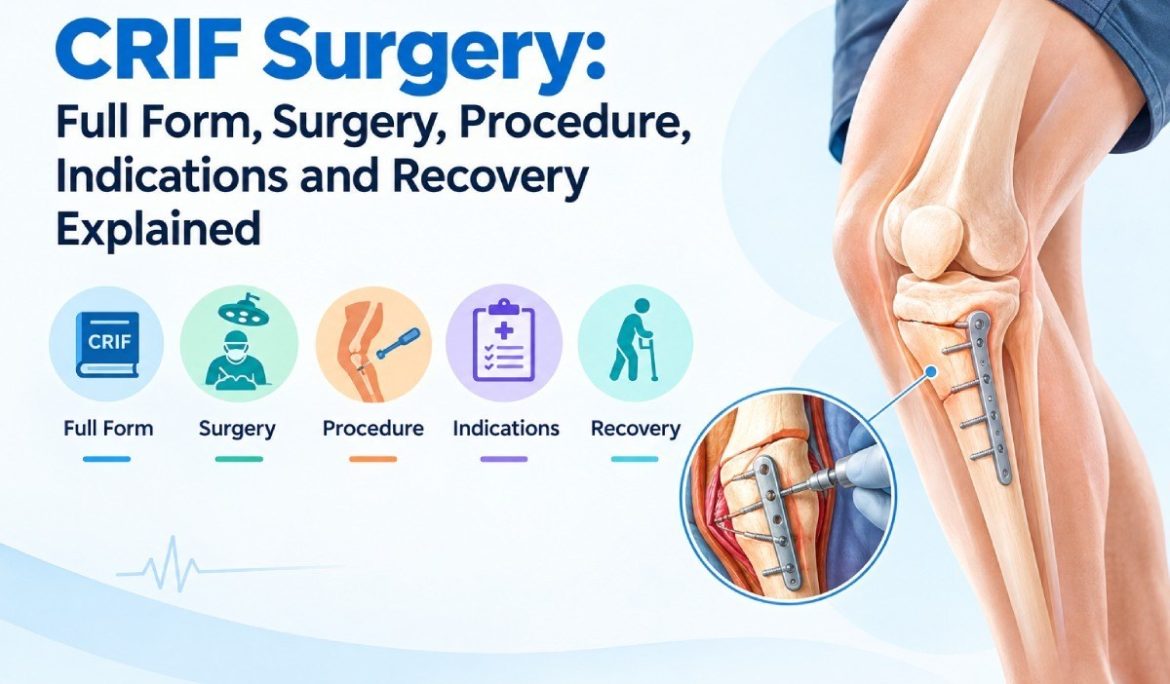
A fracture can be painful and frightening, particularly when an orthopaedic surgeon explains that the broken bone needs to be stabilised with a procedure called CRIF surgery. Patients and family members often have questions: What is the CRIF full form in medical terminology? Does the procedure involve a large incision? Will a metal nail or plate be inserted into the bone? How long does recovery take?
CRIF stands for Closed Reduction and Internal Fixation. It is an orthopaedic procedure in which the surgeon realigns a fractured bone without surgically exposing the fracture site and stabilises the bone using suitable internal fixation devices. Depending on the fracture, these may include pins, wires, screws, nails or other implants.
CRIF is not required for every fracture. Some broken bones can heal with a cast, splint or other non-surgical treatment. The decision depends on the bone involved, the position of the fragments, the stability of the fracture and the patient’s overall condition.
This guide explains CRIF surgery in simple language, including its full form, indications, procedure, use of an IMIL nail, recovery time, possible complications, and questions to ask your orthopaedic surgeon.
What Is the CRIF Full Form in Medical Terms?
The CRIF full form in medical terminology is Closed Reduction and Internal Fixation.
The name describes two parts of the procedure:
- Closed reduction: The surgeon brings the broken bone fragments into a more appropriate position without directly opening the skin and exposing the fracture site.
- Internal fixation: A suitable device is used to hold the bone fragments in position while the bone heals.
The surgeon may use X-ray guidance during the procedure to check the alignment of the fracture and the placement of the fixation device. The exact technique depends on the location and pattern of the fracture.
The word “closed” does not necessarily mean that no incision is made anywhere. Small incisions may be required to insert pins, wires, screws or a nail. The important distinction is that the fracture site itself is not surgically exposed in the same way as it is during an open reduction.
What Is Closed Reduction Internal Fixation?
Closed reduction internal fixation is a method of treating selected fractures while limiting the need to expose the broken bone directly. First, the surgeon restores the alignment of the fractured bone using appropriate manoeuvres and imaging guidance. The bone is then stabilised using a fixation device selected for that particular injury.
The aim is to maintain satisfactory alignment while the body repairs the fracture. Correct alignment and appropriate stabilisation help support bone healing, but the final outcome also depends on factors such as the fracture’s severity, blood supply, soft-tissue condition and the patient’s general health.
Why Is CRIF Surgery Performed?
The purpose of CRIF surgery is to restore the position of a fractured bone and maintain that position during healing when non-surgical treatment alone may not provide adequate stability.
Depending on the injury, a surgeon may consider CRIF when:
- A fracture is displaced and needs to be realigned.
- The fracture is unstable and is likely to lose its position without fixation.
- The fracture pattern is suitable for closed reduction and percutaneous or internal stabilisation.
- A suitable fixation device can maintain alignment without directly exposing the fracture site.
- The surgeon believes that this approach offers an appropriate balance between fracture stability and soft-tissue preservation.
Not every displaced fracture can be treated with CRIF. Some fractures require open reduction because the fragments cannot be aligned adequately through closed techniques, or because direct visualisation and additional repair are necessary. The decision is based on the specific injury rather than the procedure’s name alone.
Which Fractures May Be Treated with CRIF?
CRIF may be considered for selected fractures in different parts of the body. The suitability of the procedure depends on the exact bone, fracture location, fragment displacement, stability, and fixation method.
1. Selected long-bone fractures
Some fractures of long bones, including the femur or tibia, may be treated with a suitable intramedullary nail when the fracture pattern allows appropriate alignment and fixation. An intramedullary nail passes through the central canal of the bone. The surgeon may use imaging guidance and locking screws to help maintain the position of the fracture.
2. Selected forearm and upper-limb fractures
Certain fractures involving the forearm, wrist or other upper-limb bones may be treated using closed reduction and fixation with appropriate wires, pins or other devices. The choice depends on the patient’s age, the bone involved, whether the fracture affects a joint and whether the position can be maintained safely.
3. Selected ankle and other lower-limb fractures
Some fractures around the ankle or other lower-limb areas may be suitable for closed reduction and fixation. However, fractures involving joint surfaces or complex patterns may require a different approach.
4. Fractures in children
Some fractures in children can be treated using closed reduction and percutaneous fixation, often with wires or pins. The treatment plan must account for the child’s age, growth plates, fracture pattern, and healing potential.
Important: These are examples, not a list of automatic indications. A fracture in any of these locations may require a cast, a different fixation technique, or open surgery instead.
CRIF Surgery Procedure: What Happens Step by Step?
The precise procedure varies according to the fracture and the fixation device selected. The following steps describe the general process.
Step 1: Clinical assessment and imaging
The orthopaedic surgeon examines the injured area, assesses swelling and skin condition, and checks circulation, sensation and movement where appropriate. X-rays are usually required to determine the fracture’s location, alignment and pattern.
A CT scan may be recommended for complex fractures or injuries involving a joint surface. The surgeon also considers the patient’s medical history, medications, allergies, other injuries and suitability for anaesthesia.
Step 2: Anaesthesia and preparation
CRIF surgery is performed with an appropriate anaesthetic technique. Depending on the injury and the procedure, this may involve general anaesthesia, regional anaesthesia or another suitable method. The surgical team prepares the area and uses imaging equipment when needed to guide reduction and fixation.
Step 3: Closed reduction of the fracture
The surgeon manoeuvres the fractured bone fragments into a more appropriate position without directly exposing the fracture site. This may involve carefully applied traction, rotation or other controlled movements.
X-ray imaging helps the surgeon assess whether the fragments have been adequately aligned. If satisfactory alignment cannot be achieved or maintained, the surgeon may need to reconsider the technique. In some cases, an open reduction may be necessary.
Step 4: Internal fixation
Once the fracture has been reduced, the surgeon stabilises it using an appropriate fixation device. Depending on the fracture, the device may be a nail, pin, wire, screw or another suitable implant. Some procedures use small incisions to insert the device while keeping the fracture site itself closed.
For example, a suitable fracture of a long bone may be stabilised with an intramedullary nail. A different fracture may be better treated with wires or screws. The objective is to provide sufficient stability for healing while respecting the anatomy and soft tissues around the injury.
Step 5: Imaging and stability checks
The surgical team checks the alignment of the fracture and the position of the fixation device using appropriate imaging. The surgeon also assesses whether the fixation provides the required stability. The wound or small insertion sites are then dressed, and a splint or other support may be used if needed.
Step 6: Postoperative monitoring
After surgery, the patient is monitored while recovering from anaesthesia. Pain control, swelling, circulation, sensation and movement are assessed as appropriate. The surgeon explains wound care, medications, follow-up appointments, exercises and restrictions on movement or weight-bearing. Depending on the fracture, the patient’s condition and the operation performed, discharge may be possible on the same day or after a hospital stay.
CRIF with IMIL Nail: What Does It Mean?
The phrase CRIF with IMIL nail is used in orthopaedic practice, particularly in India, to describe a closed reduction and internal fixation procedure in which an intramedullary interlocking nail is used. An intramedullary nail is a metal implant placed inside the central canal of a bone.
Interlocking screws are inserted through the nail and into the bone to help control movement and maintain alignment. This type of fixation is used for selected fractures, particularly certain fractures of long bones such as the femur and tibia. The suitability of the nail depends on the location, pattern, and stability requirements of the fracture.
How does an IMIL nail work?
A long bone has a central canal. When an intramedullary nail is appropriate, the surgeon places the nail within this canal and secures it with locking screws. The nail helps support the bone internally while the fracture heals.
The locking screws help control rotation and length, depending on the fracture pattern and fixation construct. The procedure may involve small incisions, and imaging is used to guide placement and check alignment. The exact surgical steps vary according to the bone and implant system.
Is CRIF the same as an IMIL nail?
No. These terms describe different aspects of fracture treatment.
- CRIF describes the reduction approach and internal stabilisation of the fracture.
- IMIL nail describes a type of internal fixation implant.
An intramedullary nail may be used during a CRIF procedure when the fracture is suitable for that technique.
However, CRIF does not always involve an IMIL nail. Other fixation devices may be more appropriate for other fractures. The term “CRIF with IMIL nail” should therefore be understood in the context of the specific bone and fracture being treated.
CRIF vs ORIF: What Is the Difference?
CRIF and ORIF are both approaches to fracture treatment, but they differ in how the surgeon accesses and reduces the broken bone.
| Feature | CRIF | ORIF |
| Full form | Closed Reduction and Internal Fixation | Open Reduction and Internal Fixation |
| Fracture-site access | The fracture site is not directly exposed | The surgeon makes an incision to expose the fracture site |
| Reduction method | Bone alignment is restored using closed techniques and imaging | The surgeon directly visualises and realigns the bone fragments |
| Fixation devices | May include nails, pins, wires, screws or other suitable implants | May include plates, screws, nails or other implants |
| When considered | When satisfactory reduction and fixation can be achieved without directly exposing the fracture | When direct access is needed to achieve reduction, repair associated damage or obtain suitable fixation |
| Recovery | Depends on the fracture and fixation method | Depends on the fracture and fixation method |
Neither approach is automatically better for every fracture. The appropriate method is the one that can achieve suitable alignment and stability for the particular injury while accounting for soft tissues and other clinical factors.
CRIF Surgery vs Cast Treatment: Which Is Needed?
Not every fracture requires surgery. Many fractures can heal with a cast, splint, brace, or other non-surgical treatment when the bone fragments are adequately aligned, and the position can be maintained.
CRIF may be considered when the fracture needs reduction and additional internal stabilisation. The decision depends on whether the bone can heal in an acceptable position without surgery and whether the fracture is likely to remain stable.
A cast may avoid the risks of an operation, but it may not be suitable for every unstable or displaced fracture. Conversely, surgery introduces risks associated with anaesthesia, the procedure, and the fixation device. The choice should be based on the expected healing and functional outcome, not simply on whether a treatment is surgical or non-surgical.
What Is the Recovery Time After CRIF Surgery?
CRIF recovery time varies according to the bone involved, fracture severity, fixation method, and the patient’s healing progress. There is no single recovery timeline that applies to every CRIF procedure. Some fractures show meaningful healing over approximately 6-12 weeks, but more complex injuries and fractures of major long bones may take several months or longer to heal sufficiently for unrestricted activity.
Bone healing and complete functional recovery are not always the same thing. A patient may be able to move a joint or begin physiotherapy before the fracture has fully healed. Conversely, pain may improve before the bone is strong enough to tolerate normal loading.
First few days after surgery
The early focus is on controlling pain and swelling, protecting the operated area and monitoring for complications. The patient may be advised to elevate the affected limb, keep the wound clean and dry according to instructions, and take prescribed medication.
The surgical team will explain how to move safely and whether a cast, splint, sling, walker or crutches are needed. Weight-bearing should not be assumed to be safe just because the patient has undergone fixation.
First two weeks
Follow-up may be required to assess the wound, swelling, pain, and early recovery. The surgeon will explain whether the dressing needs to be changed and when the wound can get wet. Depending on the fracture, gentle movement of nearby joints may be encouraged to limit stiffness.
Other movements may need to be restricted to protect the fracture and fixation. Do not begin exercises or increase activity beyond the plan provided by the treating team.
Weeks 2-6
During this period, the focus is often on protecting the fracture while maintaining safe movement and muscle function. The surgeon may review X-rays and assess whether the fracture remains aligned. Physiotherapy may be introduced or progressed depending on the injury and fixation stability.
Some patients may be allowed to increase weight-bearing gradually, while others need continued restrictions. These decisions should be based on the fracture and follow-up findings, not on a general recovery timetable.
Weeks 6-12
Some fractures show substantial healing during this period, although the rate varies. The surgeon may use clinical assessment and imaging to decide whether activity can be increased. Rehabilitation may focus on improving joint movement, strength, balance and the ability to perform daily activities safely.
Patients should not independently stop using crutches, resume heavy lifting or return to impact activities simply because pain has decreased.
Beyond three months
More complex fractures may require several additional months for bone healing and functional recovery. Some patients need a longer rehabilitation programme to regain strength, mobility and confidence.
Return to work, driving, sports and physically demanding tasks depends on the fracture location, healing progress, movement, strength, medication use and the requirements of the activity.
The treating surgeon should confirm when these activities can be resumed safely.
What Factors Affect CRIF Recovery Time?
Several factors can influence recovery after CRIF surgery.
1. The bone and fracture pattern
Different bones heal under different mechanical conditions. A simple fracture may recover differently from a fracture involving multiple fragments, a joint surface or a major weight-bearing bone.
2. Fracture stability and fixation
The type of implant and the stability it provides influence when movement and weight-bearing can be increased. A fixation method suitable for one fracture may not be suitable for another.
3. Blood supply and soft-tissue injury
The surrounding muscles, skin, and blood supply are important to healing. Severe trauma or damage to the soft tissues can make recovery more complicated.
4. Age and general health
Age alone does not determine recovery, but overall health can influence healing. Conditions such as diabetes, poor circulation, and certain bone-health problems may affect the process.
5. Smoking and nutrition
Smoking can impair bone healing. Adequate nutrition, including sufficient protein and a balanced intake of essential nutrients, supports the body’s repair processes. Patients should discuss nutritional concerns, supplements and smoking cessation with their healthcare team rather than relying on unverified remedies.
6. Physiotherapy and adherence to restrictions
Appropriate rehabilitation helps restore movement, strength and function. However, doing too much too soon can put the fracture at risk.
Following weight-bearing instructions, attending follow-up appointments, and reporting new symptoms are important parts of recovery.
Weight-Bearing After CRIF Surgery: Can You Walk?
Whether a patient can walk after CRIF depends on the bone treated, fracture pattern, and fixation stability. Some patients may be allowed to bear weight early with assistance. Others may be instructed to avoid weight-bearing or place only limited weight through the injured limb for a period of time.
Your surgeon may recommend a walker, crutches, or another support. If the injury involves an arm, restrictions may relate to lifting, pushing, pulling, or supporting body weight through the arm. Do not use another patient’s recovery experience as a guide. Two patients with what sounds like the same fracture may have different fixation methods and different restrictions.
Before leaving the hospital, make sure you understand:
- Whether you can put weight on the affected limb.
- Whether the restriction is non-weight-bearing, partial weight-bearing, or weight-bearing as tolerated.
- Which walking aid or support to use.
- Which exercises are allowed.
- When the restrictions will be reviewed.
What Are the Possible Risks and Complications of CRIF Surgery?
CRIF is performed to stabilise a fracture, but no operation is completely free of risk. The possible complications depend on the injury, the fixation device, the surgical technique, and the patient’s health.
Potential complications include:
- Infection: Infection may affect the wound or, less commonly, the bone or implant.
- Bleeding or swelling: These can occur after surgery and require appropriate monitoring.
- Nerve or blood-vessel injury: Nearby structures may be affected by the original trauma or, less commonly, by treatment.
- Loss of alignment: The bone fragments may shift despite fixation.
- Delayed union or nonunion: The fracture may take longer than expected to heal or may fail to unite.
- Malunion: The bone may heal in an unsatisfactory position.
- Implant-related problems: The fixation device may loosen, break, become prominent, or cause irritation.
- Joint stiffness or reduced muscle strength: These may develop during recovery, particularly after prolonged immobilisation.
- Blood clots: Certain injuries and periods of reduced mobility increase the risk of clots.
Some complications may require additional treatment or, occasionally, another operation. Your surgeon can explain which risks are most relevant to your particular fracture and how they will be monitored.
Warning signs that need medical attention
Seek urgent medical assessment if you develop severe or rapidly increasing pain, new numbness, unusual weakness, a cold or discoloured hand or foot, rapidly increasing swelling, fever with worsening wound symptoms, or discharge from the wound.
Chest pain, sudden breathlessness or coughing up blood can indicate a potentially serious emergency. Seek emergency medical care rather than waiting for a routine follow-up.
How Can You Support Recovery After CRIF Surgery?
Recovery is a combination of fracture protection, follow-up care, and gradual rehabilitation.
- Follow your weight-bearing instructions: Do not increase walking or lifting simply because the pain has improved.
- Attend follow-up appointments: The surgeon may assess the wound, fracture alignment and signs of healing using X-rays or other investigations when needed.
- Take care of the wound: Follow the instructions on dressing changes, bathing and signs of infection.
- Follow the prescribed rehabilitation plan: Exercises should match the fracture, fixation and stage of recovery. Do not copy an exercise programme designed for a different injury.
- Eat a balanced diet: Adequate calories, protein and essential nutrients support normal healing. If you have diabetes or another condition that may affect healing, follow your clinician’s advice on managing it.
- Avoid smoking: Smoking can interfere with bone healing. Seek help with cessation if needed.
- Prepare your home for safe movement: Keep walking routes clear, arrange frequently used items within reach, and use the prescribed walking aid. Assistance may be useful during the early recovery period.
Frequently Asked Questions About CRIF Surgery
1. What is the CRIF full form in medical terminology?
CRIF stands for Closed Reduction and Internal Fixation. It describes a procedure in which a fracture is realigned without directly exposing the fracture site and stabilised using an appropriate internal fixation device.
2. Is CRIF surgery a major operation?
It depends on the fracture and the procedure required. Some CRIF procedures are relatively limited, while others involving major bones and complex injuries require substantial surgery and postoperative care. The treating surgeon can explain the expected complexity in your case.
3. Is CRIF surgery performed without an incision?
The fracture site is not directly exposed during closed reduction, but small incisions may be needed to insert fixation devices. The size and location of the incisions depend on the technique used.
4. What is CRIF with an IMIL nail?
It refers to closed reduction and internal fixation using an intramedullary interlocking nail. The nail is placed inside the central canal of a suitable bone and secured with locking screws. It is one possible fixation method, not a requirement for every CRIF procedure.
5. Is CRIF the same as an IMIL nail?
No. CRIF describes the method of reducing and stabilising the fracture, while an IMIL nail is a type of implant. A CRIF procedure may use a nail or another suitable fixation device.
6. What is the difference between CRIF and ORIF?
In CRIF, the fracture is reduced without directly exposing the fracture site. In ORIF, the surgeon makes an incision to expose and realign the bone fragments. The choice depends on the fracture pattern and the reduction and fixation required.
7. How long does CRIF surgery take?
The duration varies with the bone involved, the complexity of the fracture, the fixation method, and whether additional injuries need treatment. Your surgical team can provide a more meaningful estimate after assessing the injury.
8. What is the CRIF recovery time?
Recovery varies by fracture. Some fractures heal substantially over about 6–12 weeks, while complex fractures may take several months or longer. Return to normal function can take additional time.
9. Can I walk immediately after CRIF surgery?
Some patients can walk with assistance, while others must avoid weight-bearing or follow strict limits. Follow the instructions given for your particular fracture and fixation method.
10. Will the metal implant need to be removed?
Not always. Some implants can remain in place indefinitely. Removal may be considered if the implant causes problems or there is another clinical reason, but it requires an individual assessment. Implant removal is another procedure and is not automatically necessary after healing.
11. Is CRIF better than treatment with a cast?
Neither option is universally better. A cast may be sufficient when the fracture is aligned and stable. CRIF may be considered when internal stabilisation is needed to maintain alignment. The decision depends on the specific injury.
12. What happens if a fracture does not heal after CRIF?
Delayed healing or nonunion requires reassessment. The surgeon may review X-rays, symptoms, stability, infection risk, and factors such as smoking or underlying health conditions. Further treatment depends on the reason healing has not progressed as expected.
13. Can I return to work after CRIF surgery?
Return to work depends on the fracture, recovery, transport requirements and the physical demands of the job. A desk-based role may require a different recovery plan from a job involving prolonged standing, lifting or manual work.
14. Do I need physiotherapy after CRIF?
Physiotherapy may be recommended to maintain joint movement and restore strength, balance and function. The timing and exercises depend on the fracture and the surgeon’s restrictions. Some exercises may begin early, while others must wait until healing allows them.
15. When should I contact my orthopaedic surgeon after CRIF?
Attend scheduled follow-ups and contact the treating team if symptoms worsen, the wound becomes increasingly red or starts discharging, or you have concerns about your movement or recovery. Severe pain, new loss of sensation, a cold or discoloured limb, or symptoms suggesting a blood clot require urgent assessment.
Conclusion: Understanding CRIF Surgery and Your Recovery
CRIF surgery, or Closed Reduction and Internal Fixation, is one approach to treating selected fractures. It allows the surgeon to restore bone alignment without directly exposing the fracture site and to stabilise the bone using a suitable internal fixation device.
An IMIL nail is one possible option, particularly for selected long-bone fractures, but it is not used in every CRIF procedure. Plates, screws, pins, wires or other methods may be more appropriate for different injuries.
Recovery depends on the fracture, the stability of the fixation, the patient’s health and the progress of bone healing. Follow-up imaging, safe movement, appropriate rehabilitation and adherence to weight-bearing restrictions all contribute to recovery.
If you have sustained a fracture, ask your orthopaedic surgeon why a particular fixation method is recommended, what restrictions apply, and how healing will be monitored. A treatment plan tailored to the actual injury is more useful than relying on a standard recovery timeline.
About Dr. Tushar Kadam
Dr. Tushar Kadam is an orthopaedic surgeon in Thane. Patients seeking advice about fractures can consult an orthopaedic specialist near me for an assessment of the injury, review of imaging, and discussion of appropriate treatment options. For information about Dr. Kadam’s qualifications, clinical services, and appointment details, visit the official website and About Dr. Tushar Kadam.
Medical disclaimer: This article is for general educational purposes and does not replace an individual medical assessment. Treatment, weight-bearing restrictions, and recovery timelines should be determined by the treating orthopaedic team.