

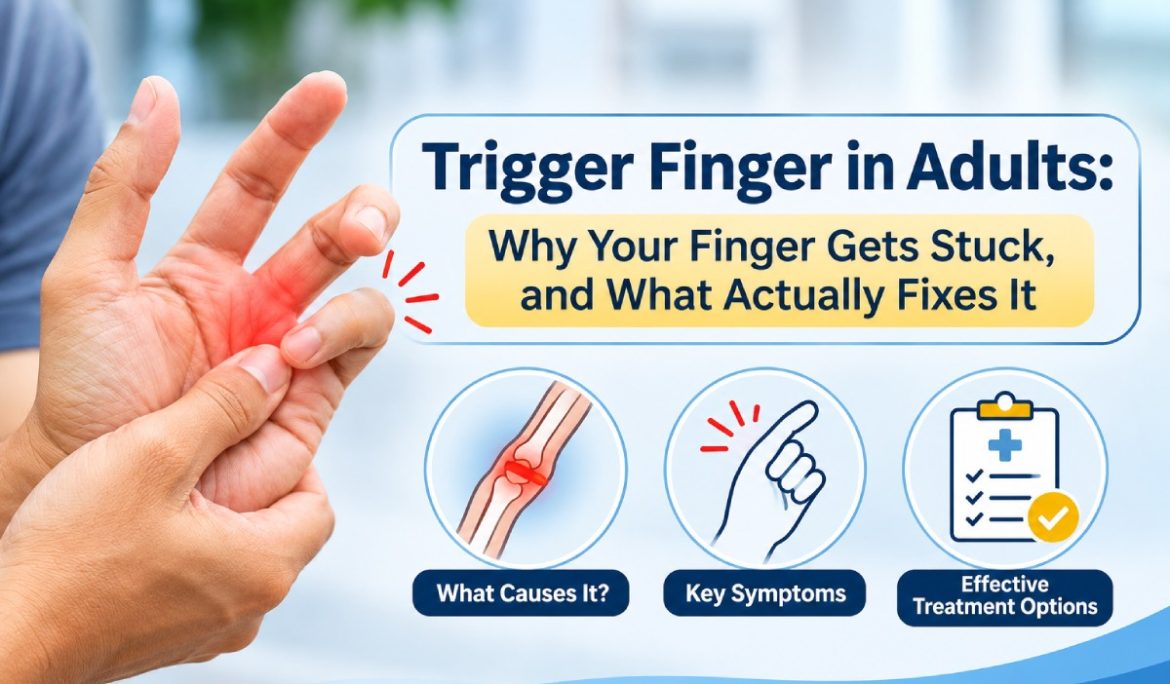
“Doctor, my ring finger gets stuck every morning. I have to pull it straight with my other hand, and it snaps open with a click.” This is how a 48-year-old homemaker from Thane described her problem. She had been cutting vegetables, wringing clothes and kneading dough for years, and had assumed the stiffness would settle on its own.
It didn’t. Over three months, the catching got worse, the base of her finger became tender, and one morning it refused to straighten at all. She was understandably worried, but the cause turned out to be one of the most common and most treatable hand conditions we see: trigger finger.
If you have a stuck finger that clicks, catches, or locks, understanding the available Trigger Finger Treatment options can help you identify the right approach, from conservative care to a day-care pulley release procedure. For other bone, joint, and tendon-related concerns, consult an experienced Orthopedic Doctor in Thane for an appropriate evaluation.
What Is Trigger Finger?
Trigger finger, also called stenosing tenosynovitis, is a condition where a finger or thumb catches or locks when you bend it. The finger may get stuck in a bent position and then suddenly snap straight, a bit like pulling and releasing a trigger. That is how it got its name.
To understand why, picture how your fingers work. Tendons run from your forearm muscles to your finger bones, like cords. In the palm, these tendons pass through a series of small tunnels called pulleys, which hold the tendon close to the bone so the finger bends smoothly.
In trigger finger, the first pulley at the base of the finger (called the A1 pulley) becomes thickened and tight. The tendon also develops a small swelling or nodule. Now the swollen tendon struggles to glide through the narrow tunnel. It catches, then pops through, which causes the click, the pain, and the locking.
Early Trigger Finger Treatment can help reduce discomfort, improve finger movement, and prevent persistent locking in many patients. Trigger finger can affect any finger or the thumb, and more than one digit can be involved at the same time. The thumb and ring finger are the most commonly affected.
Causes and Risk Factors
In most people, trigger finger develops slowly with no single cause. Understanding the common Trigger Finger Causes is important, particularly for people with diabetes, inflammatory conditions, or repetitive gripping habits. Irritation of the tendon and pulley builds up over time.
These factors raise the risk:
- Repetitive or forceful gripping: chopping vegetables, wringing clothes, kneading dough, using hand tools, riding a two-wheeler with a tight grip on the handle, or long hours of driving
- Being a woman between 40 and 60 years of age, the group in which it is most often seen
- Diabetes: one of the strongest risk factors, and trigger finger tends to be more stubborn and affect multiple fingers in people with diabetes
- Rheumatoid arthritis and other inflammatory conditions, which cause swelling of the tendon lining
- Gout and raised uric acid, which can irritate tendons around the hand
- Underactive thyroid (hypothyroidism)
- Carpal tunnel syndrome, which often occurs alongside trigger finger
- Previous trigger finger in another digit, or a prior hand injury or surgery
For office-goers, long hours of typing, mouse use, or heavy smartphone use are often blamed. The evidence that these alone cause trigger finger is limited, but constant gripping and repetitive finger movement can certainly aggravate it once it starts.
Trigger Finger Symptoms and Warning Signs
Symptoms usually creep in gradually and are often worst first thing in the morning.
- Stiffness in the finger or thumb when you wake up, which eases as you use the hand
- A clicking, popping, or catching sensation as you bend and straighten the finger
- A tender, pea-sized lump at the base of the finger in the palm, which you can feel when you press
- The finger locking in a bent position, needing the other hand to straighten it
- Pain at the base of the finger or in the palm, sometimes spreading into the finger
- In advanced cases, the finger stays stuck bent and cannot be straightened even with help
Recognising Trigger Finger Symptoms early, especially morning stiffness, clicking, and finger locking, can help patients seek appropriate treatment before the condition progresses.
Importantly, pain at the base of the finger, not in the middle joint, is the typical clue. If the finger is red, hot, swollen all over, or you have a fever, that is a different problem and needs urgent attention.
Trigger Finger vs Other Hand Problems
| Condition | Key Feature | How It Differs from Trigger Finger |
| Trigger finger | Clicking or locking, tender nodule at the base of the finger in the palm | Catching is the main problem; the joints themselves move freely when helped |
| Finger or hand arthritis | Stiff, swollen, painful joints, often with bony enlargement | Pain is in the joints, with no snapping release |
| Dupuytren’s contracture | Painless thick cord in the palm that gradually pulls the finger into a bend | The finger cannot be straightened because of a fixed cord, not a sudden snap |
| Carpal tunnel syndrome | Numbness and tingling in the thumb, index and middle fingers, often at night | Mainly a nerve problem; no locking |
| Ganglion or other palm lump | A visible or palpable lump | Does not move with the tendon or cause locking |
Because several of these conditions can overlap, a proper examination matters before starting treatment. Identifying the underlying Trigger Finger Causes is important because conditions such as diabetes, arthritis, and repetitive hand movements may influence symptom severity and treatment outcomes. Learn more about Carpal Tunnel Syndrome, another hand-related condition that can cause numbness and tingling
How Is Trigger Finger Diagnosed?
Trigger finger is usually diagnosed from your story and a simple hand examination. No scans are needed in most cases. During the examination, an orthopaedic surgeon evaluates the Trigger Finger Symptoms and checks tendon movement to distinguish the condition from other hand problems.
- History: when it started, whether it is worse in the morning, any locking, and whether you have diabetes, thyroid problems, or arthritis.
- Examination: feeling for the tender nodule at the base of the finger, and watching you open and close your hand to see the catching or locking.
- Checking other digits and the wrist, since trigger finger and carpal tunnel syndrome often occur together.
- Blood tests, if needed: blood sugar, HbA1c, thyroid function, uric acid or rheumatoid markers, to look for an underlying cause.
- Ultrasound or X-ray, only when the diagnosis is unclear or another condition such as arthritis or a lump is suspected.
Treatment Options
Trigger Finger Treatment follows a step-by-step approach based on how long the condition has been present, the severity of locking, and whether the patient has diabetes or inflammatory arthritis.
Depending on the diagnosis, Stenosing Tenosynovitis Treatment may involve splinting, medication, steroid injections, or a minor surgical procedure.
| Treatment | What It Involves | Who It Suits |
| Rest and activity changes | Avoiding repetitive gripping, using padded handles, warm soaks | Mild, early trigger finger with occasional clicking |
| Night splinting | A small splint keeps the finger gently straight at night, usually for about 6 weeks | Mild to moderate cases, especially with morning stiffness |
| Anti-inflammatory medication | Short course of tablets or a topical gel to ease pain | Pain relief while other treatments take effect |
| Steroid injection | A small injection around the tendon sheath at the base of the finger | Most people with moderate trigger finger who need faster relief |
| Pulley release (A1 pulley release) | A short procedure that opens the tight pulley so the tendon glides freely | Persistent or recurrent locking, a finger stuck bent, or when injection hasn’t worked |
The choice of Stenosing Tenosynovitis Treatment depends on whether the patient has mild clicking, painful locking, or persistent restriction in finger movement. Explore the available Orthopaedic Treatment Options to understand different approaches to managing bone, joint and tendon conditions.
Steroid injection
A steroid injection reduces swelling around the tendon and often settles the problem. Many patients improve within a few days to two weeks. A single injection works for a good proportion of people, but success is lower, and recurrence more common, in people with diabetes or when more than one finger is involved.
Side effects are usually minor, such as temporary soreness, but in people with diabetes, blood sugar may rise for a few days, so close monitoring is advised. Steroid injections are an important option in Stenosing Tenosynovitis Treatment, particularly when conservative measures have not provided sufficient relief.
Trigger Finger Release Surgery
When splints and injections don’t solve the problem, Trigger Finger Surgery through an A1 pulley release is a simple and highly effective solution. It is usually done as a day-care procedure under local anaesthesia, so you are awake but your hand is numb.
A small cut is made in the palm, or in some cases a needle is used, and the tight A1 pulley is released. The tendon can then glide freely again. Trigger Finger Release Surgery is generally considered when persistent locking interferes with daily activities or when other treatment options have not worked.
Pulley release has a very high success rate, and the locking rarely returns in the same finger. As with any procedure, there are small risks such as stiffness, infection, wound tenderness, or, very rarely, nerve injury. Your surgeon will explain these before you decide.
Trigger Finger Exercises and Lifestyle Advice
Trigger Finger Exercises and appropriate self-care can help manage stiffness in the early stages and support recovery after treatment. Never force a locked finger straight, as this can aggravate the tendon.
- Soak your hand in warm water for 10 minutes in the morning to ease stiffness, then gently move the finger
- Do gentle tendon-gliding exercises: open the hand fully, then make a hook fist, a full fist, and a straight fist, moving slowly through each position, a few times a day
- Use padded handles on kitchen tools, scooters or bikes, and avoid a very tight grip where possible
- Take breaks during repetitive tasks such as chopping, wringing, typing or long drives, and shake out or stretch the hands
- Use both hands to lift heavy vessels instead of gripping with a single hand
- Control blood sugar well if you have diabetes, since this improves outcomes with every treatment
- Wear a night splint if advised, consistently, rather than occasionally
Regular Trigger Finger Exercises, performed gently without forcing the affected finger, can help maintain mobility and flexibility.
Recovery Timeline
| Treatment | What to Expect |
| Rest, soaks and exercises | Gradual improvement over several weeks if the condition is mild |
| Night splint | Benefit usually seen over 4 to 6 weeks of regular use |
| Steroid injection | Relief often begins within a few days and peaks by about 2 weeks; effect may last months or longer |
| Pulley release: first days | Light use of the hand is encouraged right away; keep the wound clean and dry |
| Pulley release: 10 to 14 days | Stitches are typically removed; most patients return to desk work and light chores |
| Pulley release: 4 to 6 weeks | Full strength and grip usually return; heavy lifting resumes as advised |
Following Trigger Finger Release Surgery, patients should gradually resume daily activities and follow their surgeon’s advice regarding wound care and hand movement. Scar tenderness in the palm can last a few weeks and usually settles with gentle massage and regular hand use.
Prevention Tips
- Avoid sustained, tight gripping for long periods, and take short breaks to relax the hand
- Keep diabetes, thyroid conditions and inflammatory arthritis well controlled
- Use tools with larger or cushioned handles
- Do a few hand stretches during the day, especially if you type or cook for long hours
- Don’t ignore early morning clicking or a tender lump at the base of a finger; early treatment is simpler and more successful
When Should You Consult an Orthopaedic Surgeon in Thane?
- Your finger clicks or catches for more than a few weeks
- Your finger locks in a bent position, or you need to pull it straight with the other hand
- The finger is stuck and will not straighten at all
- You have diabetes or rheumatoid arthritis and notice any triggering, as it tends to be more persistent
- More than one finger is affected
- Pain, redness, swelling or fever develop in the finger or hand, which can signal infection and needs urgent assessment
- You also have numbness or tingling in the hand, which may point to carpal tunnel syndrome
Seeing a surgeon early often means a simple injection or splint is enough. Waiting until the finger is permanently stuck can lead to stiffness in the joints that is harder to treat.
Frequently Asked Questions
1. What causes a finger to get stuck in a bent position?
It happens when the tendon that bends the finger gets swollen and cannot slide smoothly through a tight pulley at the base of the finger. The tendon catches, then pops through, causing clicking and locking. This condition is called trigger finger. Identifying the underlying Trigger Finger Causes helps determine the most appropriate treatment approach.
2. Can trigger finger go away on its own?
Mild cases sometimes settle with rest and avoiding repetitive gripping, but many persist or worsen. If locking continues for more than a few weeks, medical treatment is usually needed. Depending on the severity, Trigger Finger Treatment may be needed if the symptoms persist.
3. Is trigger finger related to diabetes or rheumatoid arthritis?
Yes. Diabetes is one of the strongest risk factors, and rheumatoid arthritis and other inflammatory conditions can also cause it. Trigger finger in these patients is often more persistent and may affect several fingers.
4. Does a steroid injection cure trigger finger?
A steroid injection settles trigger finger in many patients, often within days to two weeks. It is less successful in people with diabetes or multiple affected fingers, and the problem can return, in which case pulley release is usually recommended.
5. What is a pulley release, and is it painful?
Pulley release is a short procedure that opens the tight tunnel (A1 pulley) at the base of the finger so the tendon can glide freely. It is done under local anaesthesia as a day-care procedure, and discomfort afterwards is usually mild and manageable. This procedure is also known as Trigger Finger Release Surgery.
6. How long does it take to recover after trigger finger surgery?
Most people use the hand for light tasks straight away, have stitches removed in 10 to 14 days, and regain full grip strength in about 4 to 6 weeks, though scar tenderness may linger a little longer. Recovery following Trigger Finger Surgery depends on individual healing and adherence to post-procedure advice.
7. Can trigger finger come back after treatment?
Recurrence is uncommon after pulley release in the same finger. After an injection, it can return, particularly in people with diabetes. A different finger can also develop trigger finger later. Your surgeon can recommend further Trigger Finger Treatment if symptoms return.
Book a Consultation
If your finger clicks, catches, or gets stuck, you don’t have to wait until it locks completely. A quick hand examination can identify the problem and help determine the most suitable Trigger Finger Treatment. At Tushar Nursing Home, we offer orthopaedic evaluation and treatment, including steroid injections and day-care pulley release surgery, for patients across Thane and Mumbai.
Call or WhatsApp us to book an appointment, or visit our clinic for a walk-in consultation. Expertise. Precision. Mobility.
References
- American Academy of Orthopaedic Surgeons (AAOS) — OrthoInfo: Trigger Finger, orthoinfo.aaos.org
- American Society for Surgery of the Hand (ASSH) — HandCare: Trigger Finger, assh.org
- National Health Service (NHS), UK — Trigger finger overview, nhs.uk
- Indian Society for Surgery of the Hand — Patient resources, issh.in
- Mayo Clinic — Trigger finger: symptoms, causes and treatment, mayoclinic.org
This article is for general patient education and does not replace an in-person medical consultation. Please consult an orthopaedic surgeon for diagnosis and treatment specific to your condition.