

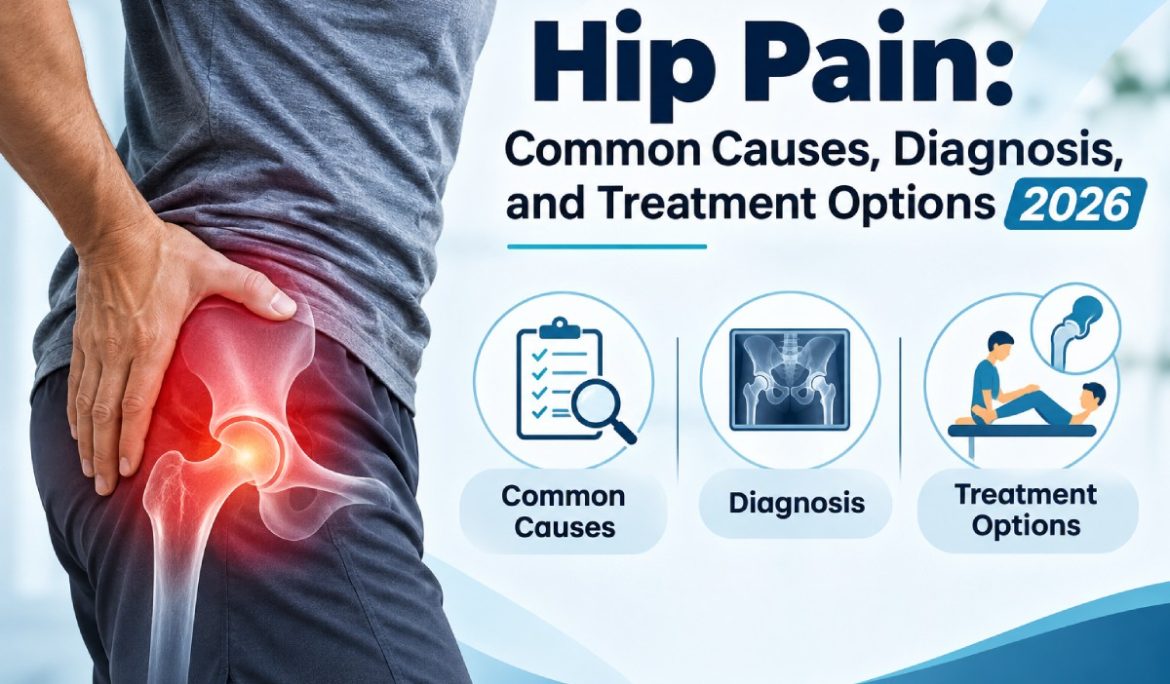
Hip pain can make everyday activities difficult. Walking to the market, climbing stairs, getting up from a chair, or sleeping comfortably may become challenging when the hip joint or surrounding tissues are painful. For some people, the discomfort develops gradually. For others, it begins after a fall, sports injury, or sudden movement.
Understanding hip pain causes and treatment depends on the structure involved, the severity of the problem, and the patient’s overall health. Osteoarthritis, tendon problems, muscle strains, bursitis, fractures, and conditions such as avascular necrosis (AVN) can all produce hip-region pain, but they require different approaches to diagnosis and care.
Osteoarthritis, tendon problems, muscle strains, bursitis, fractures, and conditions such as avascular necrosis (AVN) can all produce hip-region pain, but they require different approaches to diagnosis and care. The location of the pain provides useful clues.
Pain felt deep in the groin may be associated with the hip joint, while pain over the outer hip may involve the tendons or nearby soft tissues. Pain around the buttock can sometimes originate from the lower back or other structures. However, these patterns are not definitive. An examination is important to establish the likely cause and determine whether imaging or specialist treatment is needed.
This guide explains common hip joint pain causes, hip arthritis symptoms, hip pain while walking, diagnostic tests, and treatment options, from non-surgical care to hip replacement when appropriate.
What Is Hip Pain?
The hip is a ball-and-socket joint formed by the head of the thighbone (femur) and a socket in the pelvis called the acetabulum. Smooth cartilage covers the joint surfaces, allowing the bones to move with relatively little friction.
The hip also depends on surrounding muscles, tendons, ligaments and other soft tissues for stability and movement. Problems in any of these structures can cause pain in or around the hip.
The term “hip pain” can therefore describe several different symptoms:
- Pain deep in the groin or front of the hip.
- Pain over the outer side of the hip.
- Pain around the buttock.
- Pain that spreads down the thigh.
- Stiffness or difficulty rotating the leg.
- Pain when standing, walking, or putting weight on the leg.
Identifying the pattern helps guide the assessment, but it does not replace a clinical examination.
Common Hip Pain Causes
1. Hip osteoarthritis
Hip osteoarthritis is one of the important causes of persistent hip joint pain, particularly in middle-aged and older adults. It occurs when the cartilage covering the joint surfaces gradually deteriorates, and other joint changes develop.
As the joint changes, movement may become painful and restricted. Symptoms often develop gradually, although the rate of progression varies.
Common hip arthritis symptoms include the following:
- Pain deep in the groin or front of the hip.
- Stiffness after sitting or resting.
- Difficulty putting on shoes or socks.
- Pain while walking or climbing stairs.
- Reduced ability to rotate or bend the hip.
- A limp or shorter walking distance.
- Pain that may eventually occur at rest or at night.
Some hip arthritis symptoms include stiffness after waking up or sitting for a long time, while others experience discomfort mainly during activity. Risk factors can include increasing age, previous hip injury, certain structural hip conditions, and excess body weight.
However, osteoarthritis can develop even when a person has no obvious risk factors. A doctor may assess hip movement, walking pattern, and pain, then recommend X-rays when appropriate. X-rays can show joint-space narrowing, bone changes and bone spurs associated with osteoarthritis.
Treatment usually begins with non-surgical measures, such as suitable exercise, activity modification and pain management. Hip replacement may be considered when symptoms substantially affect daily life and appropriate non-surgical treatments no longer provide adequate relief.
2. Tendon problems around the hip
Tendons connect muscles to bones and help control movement. Tendon-related conditions around the hip can cause pain during walking, climbing stairs, standing on one leg, or exercising. One common example is gluteal tendinopathy, which affects tendons on the outer side of the hip.
It may cause pain when lying on the affected side, walking for long periods, or standing with most of the body’s weight on one leg. Tendon repair problems may develop gradually after repeated loading or an increase in activity. They can also occur following an injury.
The doctor may assess the location of tenderness, hip strength, movement, and activities that reproduce the symptoms. Treatment may include adjusting aggravating activities and following a structured rehabilitation programme. Persistent tendon pain should not automatically be attributed to arthritis. The location and clinical findings help determine which structure is likely to be involved.
3. Greater trochanteric pain syndrome
Greater trochanteric pain syndrome describes pain around the outer side of the hip. It is often associated with gluteal tendon problems and may also involve nearby soft tissues, including the bursa.
A bursa is a small fluid-filled structure that helps reduce friction between tissues. In some cases, irritation of this area contributes to symptoms, but outer-hip pain is not always caused by bursitis alone.
Possible symptoms include:
- Pain over the outer hip.
- Discomfort when lying on the affected side.
- Pain while walking, climbing stairs, or standing for a long time.
- Tenderness around the bony prominence on the side of the hip.
The diagnosis is based on the history and examination, with imaging considered in selected cases. Treatment may include modifying activities that aggravate the pain, physiotherapy, and medication when appropriate. Some patients need further assessment if symptoms persist or the diagnosis is uncertain.
4. Muscle strain
Muscles around the hip and upper thigh can become strained after sudden movement, exercise, lifting or repetitive activity. A strain involves injury to muscle fibres and may cause localised pain and tenderness.
The pain may worsen when the affected muscle contracts or stretches. Some people also notice bruising or swelling, depending on the severity of the injury. A mild strain may improve with appropriate activity modification and gradual return to movement.
More severe injuries, substantial bruising, or difficulty bearing weight require medical assessment to rule out other injuries. Do not assume that sudden, severe hip pain is simply a muscle strain, particularly if it follows a fall or makes walking difficult.
5. Avascular necrosis (AVN) of the hip
Avascular necrosis, also called osteonecrosis, occurs when the blood supply to part of the bone is disrupted. In the hip, it commonly affects the femoral head, the ball at the top of the thighbone. When bone tissue does not receive sufficient blood supply, it can weaken.
As the condition progresses, the femoral head may collapse, damaging the joint surface and leading to arthritis. AVN can develop after certain injuries, including a hip dislocation or fracture. It is also associated with factors such as prolonged or high-dose corticosteroid use and excessive alcohol consumption over time. In some cases, the cause is not clear.
Possible symptoms include:
- Deep groin or hip pain.
- Pain while standing or walking.
- Pain that may spread to the buttock or thigh.
- Increasing difficulty bearing weight as the condition progresses.
Early AVN may not be visible on a plain X-ray. If the symptoms and risk factors raise suspicion, an MRI may be recommended even when an X-ray appears normal. AVN deserves timely assessment because the stage of the condition can influence the treatment options available.
Early disease may sometimes be treated with procedures intended to preserve the natural joint. If the femoral head has collapsed and the joint is severely damaged, hip replacement may be considered. Read more in our guide to understanding avascular necrosis.
6. Hip fracture
A hip fracture is a break in the upper part of the femur. It may occur after a fall or significant trauma. In people with fragile bones, even a relatively minor fall can cause a fracture.
Common warning signs include:
- Sudden, severe hip or groin pain after a fall.
- Difficulty standing or putting weight on the leg.
- Inability to walk normally.
- Pain when attempting to move the affected leg.
Some fractures may not produce all of these symptoms, so the ability to move the leg does not reliably exclude a fracture.
A suspected hip fracture requires urgent medical assessment. Do not attempt to walk through severe pain or repeatedly test the injured hip. Emergency evaluation and imaging are needed to determine the injury and appropriate treatment.
7. Inflammatory arthritis
Conditions such as rheumatoid arthritis can cause inflammation in joints, including the hip. Symptoms may include pain, stiffness, and reduced movement. Other joints may also be affected. Inflammatory arthritis may produce prolonged morning stiffness or symptoms that do not follow the usual pattern of activity-related osteoarthritis.
The doctor may consider the wider medical history, examination findings and, when indicated, blood tests or imaging. Management may involve a rheumatologist as well as an orthopaedic specialist, depending on the condition.
8. Pain originating from the lower back
Not all pain felt around the hip comes from the hip joint itself. Problems involving the lower back or nearby nerves can cause pain in the buttock, outer hip or thigh. Associated symptoms may include back pain, tingling, numbness or pain travelling down the leg.
However, these features vary and do not establish the cause on their own. The examination may include assessment of the back, nerve function, walking and hip movement. Treatment depends on whether the symptoms originate from the hip, the spine or more than one structure.
9. Other causes
Other conditions may cause hip-region pain, including stress fractures, labral injuries, infections and referred pain from other areas. An infection in or around the joint can be serious, particularly when pain occurs with fever, warmth, or feeling unwell.
Persistent or unexplained pain may also require further investigation. The purpose of the assessment is to identify the most likely cause and recognise conditions that need urgent treatment.
Where Is Your Hip Pain Located?
The location of hip pain can help guide the assessment, but different conditions can produce overlapping symptoms.
| Pain location | Possible causes a doctor may consider |
| Deep groin or front of the hip | Hip osteoarthritis, AVN, joint injury or fracture |
| Outer side of the hip | Gluteal tendinopathy, greater trochanteric pain syndrome or other soft-tissue problems |
| Buttock | Referred pain from the lower back, hip-related problems or other causes |
| Upper thigh | Hip joint disease, muscle problems, referred pain or other conditions |
| Pain after a fall | Fracture or soft-tissue injury, depending on the severity and examination |
| Pain with fever and a hot or swollen area | Possible infection or another inflammatory condition requiring urgent assessment |
This table is a starting point, not a diagnostic tool. The history, examination and appropriate investigations determine which explanation is most likely.
Why Does Hip Pain Occur While Walking?
Hip pain while walking can occur because walking places repeated loads through the hip joint and surrounding muscles. If the joint, bone, tendons, or other structures are affected, discomfort may become more noticeable during weight-bearing.
The pattern can vary:
- Pain at the beginning of walking: May occur with joint stiffness or several other conditions.
- Pain that increases with distance: May be associated with osteoarthritis, tendon problems, or other conditions affected by repeated loading.
- Pain with a limp: May reflect pain, weakness, restricted movement, or a more significant injury.
- Sudden pain after a fall: Requires assessment for a possible fracture or other injury.
- Deep pain with a history of AVN risk factors: May warrant investigation for osteonecrosis, particularly if symptoms are persistent.
Do not rely on these patterns to diagnose the cause. If pain is worsening, limiting walking or associated with weakness or other warning signs, arrange a medical assessment.
How Is Hip Pain Diagnosed?
Understanding the underlying cause is essential when determining the most appropriate hip pain causes and treatment approach. A proper diagnosis combines the patient’s history, physical examination, and investigations when required to identify the likely source of pain and understand how it affects movement and daily function.
Step 1: Medical history
The doctor may ask:
- When did the pain begin?
- Did it start suddenly or gradually?
- Was there a fall, injury, or increase in exercise?
- Where is the pain strongest?
- Does it worsen during walking, sitting, climbing stairs, or lying down?
- Is there stiffness in the morning?
- Have you noticed fever, swelling, numbness, or weakness?
- Have you had previous hip problems or surgery?
- Do you have relevant medical conditions or take long-term corticosteroid medication?
The answers help determine whether the problem is more likely to involve the joint, surrounding tissues, bone, back, or another structure.
Step 2: Physical examination
The doctor may assess the hip’s range of motion, tenderness, strength, and the way the patient stands and walks.
The examination may include:
- Observing the walking pattern and whether a limp is present.
- Checking how far the hip bends and rotates.
- Assessing tenderness around the groin, outer hip, and surrounding muscles.
- Testing selected movements against resistance.
- Examining the lower back or checking nerve function when indicated.
Some tests may reproduce pain, but no single manoeuvre confirms every hip condition. Findings are interpreted together with the history.
If a fracture or serious injury is suspected, the examination should be adapted to avoid unnecessary movement of the affected area.
Step 3: X-rays
X-rays are commonly used when the doctor suspects osteoarthritis, a fracture, or another bone-related condition. They can show changes such as joint-space narrowing, bone spurs, certain fractures, and advanced changes associated with AVN. However, an X-ray may not reveal every problem. Early AVN, some stress fractures, and soft-tissue injuries may require additional investigation.
Step 4: MRI
MRI provides detailed information about bone marrow, tendons, muscles, cartilage, and other soft tissues.
It may be recommended when:
- AVN is suspected despite a normal or inconclusive X-ray.
- A stress fracture or other injury is suspected.
- Persistent symptoms remain unexplained.
- The doctor needs more information to guide treatment.
MRI is not required for every person with hip pain. It should answer a specific clinical question and be interpreted alongside the examination.
Step 5: Ultrasound, CT or blood tests
Other investigations may be appropriate in selected cases.
- Ultrasound: May help assess some tendon problems, soft-tissue abnormalities or fluid around the joint.
- CT scan: May provide more detailed information about complex bone injuries.
- Blood tests: May be useful when infection, inflammatory disease, or another systemic condition is suspected.
The appropriate tests depend on the suspected cause, symptoms, and urgency.
Hip Pain Treatment: What Are the Options?
Choosing the right approach to hip pain causes and treatment requires identifying the underlying condition. A muscle strain, hip osteoarthritis, AVN, and a fracture do not have the same treatment requirements, so treatment should be tailored to the diagnosis.
The options may range from activity modification and rehabilitation to medication, specialist procedures, or surgery.
1. Activity modification
If pain is aggravated by certain activities, temporarily reducing those activities may help while the cause is assessed. Depending on the diagnosis, this may mean reducing long walks, repetitive stair climbing, high-impact exercise, or movements that cause significant discomfort.
Activity modification does not mean avoiding all movement indefinitely. The appropriate level of activity depends on the condition and whether weight-bearing is safe. If a fracture or significant bone problem is suspected, do not continue exercising through the pain.
2. Physiotherapy and exercise
A tailored rehabilitation programme may help improve hip strength, flexibility, balance and movement. For selected tendon conditions and hip osteoarthritis, physiotherapy may form an important part of treatment.
The exercises should be appropriate for the diagnosis and the person’s current ability. Exercise is not a universal solution for every cause of hip pain. A suspected fracture, significant acute injury or certain stages of AVN may require specific restrictions before rehabilitation can begin.
3. Medication for pain
A clinician may recommend appropriate pain-relieving or anti-inflammatory medication depending on the cause of pain, other health conditions and current medicines. These medicines may help control symptoms but do not correct every underlying problem.
Some medications are unsuitable for people with certain kidney, stomach, cardiovascular or other conditions. Consult a qualified clinician or pharmacist before using them, especially if you take regular medication or have a chronic health condition.
4. Weight management where appropriate
For people whose hip osteoarthritis is affected by excess body weight, gradual weight management may reduce the load placed on the joint and support mobility. Weight management is not the explanation or solution for every case of hip pain. It should be considered alongside the diagnosis, symptoms, nutrition, overall health, and individual goals.
5. Treatment for AVN
Treatment for avascular necrosis depends on how much bone is affected and whether the femoral head has begun to collapse. In selected early cases, a hip-preserving procedure may be considered. Core decompression is one example of a procedure that may be used in appropriate patients before substantial collapse occurs.
Once the femoral head has collapsed or the joint is severely damaged, hip replacement may be considered. The appropriate approach depends on the stage of AVN, the patient’s symptoms, and other clinical factors. Early assessment is important because treatment options may change as the condition progresses.
6. Hip replacement surgery
Hip replacement may be recommended for selected patients with advanced hip osteoarthritis or other severe joint damage when pain and disability substantially affect daily life and suitable non-surgical treatment has not provided adequate relief. During total hip replacement, the damaged joint surfaces are replaced with artificial components. The aim is to reduce pain and improve function.
The decision involves the patient’s symptoms, examination, imaging, overall health, activity goals, and the expected benefits and risks of surgery. An X-ray showing arthritis does not, by itself, mean that a person needs a replacement. Learn more about hip replacement treatment.
When Should You See an Orthopaedic Doctor for Hip Pain?
Consult an orthopedic doctor for hip pain if discomfort persists, repeatedly returns, worsens, or interferes with walking, sleep, work, or other daily activities.
An orthopaedic assessment may be especially important if:
- Pain causes a persistent limp.
- Hip movement becomes increasingly restricted.
- Pain occurs at rest or repeatedly wakes you at night.
- You have persistent deep groin pain.
- You have a history of significant hip injury.
- You have risk factors for AVN and develop unexplained hip pain.
- Symptoms do not improve with appropriate initial care.
An orthopedic doctor for hip pain can help identify the underlying cause and determine whether imaging, rehabilitation, medication, or specialist treatment is appropriate.
When is hip pain an emergency?
Seek urgent medical care if:
- You develop sudden, severe hip pain after a fall or injury.
- You cannot stand or put weight on the affected leg.
- The hip is severely painful with fever, warmth, or feeling very unwell.
- You develop sudden severe pain with rapidly worsening symptoms.
- You experience new significant weakness, numbness, or other concerning neurological symptoms.
A fracture or joint infection can require urgent treatment. Do not try to walk through severe pain or delay care while attempting home remedies.
Can Hip Pain Be Prevented?
Not every cause of hip pain can be prevented. Age-related joint changes, AVN, and certain injuries may occur despite sensible activity habits.
However, some measures can support joint and muscle health:
- Build up walking, exercise, and sports activity gradually.
- Include suitable strength and mobility exercises in your routine.
- Use appropriate technique when lifting or exercising.
- Allow adequate recovery after strenuous activity.
- Maintain a balanced diet and a healthy body weight where appropriate.
- Seek assessment after significant injuries rather than ignoring persistent symptoms.
- Discuss long-term corticosteroid use and other relevant medical risks with your treating clinician.
If you have already been diagnosed with hip arthritis, AVN, or another condition, follow the activity and treatment guidance provided for that diagnosis.
Frequently Asked Questions About Hip Pain
1. What are the most common causes of hip pain?
Common causes include hip osteoarthritis, tendon-related problems, greater trochanteric pain syndrome, muscle strains and injuries. Other conditions, including AVN, fractures, and referred pain from the lower back, may also cause symptoms. The cause depends on the history and examination.
2. Why does my hip hurt while walking?
Hip pain while walking can result from osteoarthritis, tendon problems, injuries, and other conditions that affect weight-bearing. Persistent or worsening pain should be assessed rather than attributed to age or overuse alone.
3. What are the common hip arthritis symptoms?
Hip arthritis may cause groin pain, stiffness after rest, reduced hip movement, difficulty walking, and discomfort during activities such as putting on shoes or getting out of a chair. Symptoms vary, and the diagnosis may require an examination and X-rays.
4. Can hip pain come from the lower back?
Yes. Problems involving the lower back or nerves can cause pain around the buttock, outer hip, or thigh. A clinical examination can help determine whether the symptoms originate from the hip, the spine, or both.
5. Does hip pain always require an X-ray?
No. The need for imaging depends on the symptoms, examination, and suspected diagnosis. X-rays are useful for many bone and joint problems, while MRI or other tests may be appropriate in selected cases.
6. Can hip pain improve without surgery?
Yes. Many causes of hip pain can be managed without surgery, depending on the diagnosis. Options may include activity modification, physiotherapy, and appropriate medication. Some fractures, advanced joint conditions, or other significant problems may require procedures or surgery.
7. What is the difference between hip arthritis and AVN?
Hip osteoarthritis involves degenerative changes in the joint cartilage and other joint structures. AVN occurs when the blood supply to part of the bone is disrupted, potentially leading to bone collapse and secondary arthritis. The conditions can overlap in advanced disease but have different underlying mechanisms.
8. Can AVN be detected on an X-ray?
More advanced AVN may be visible on an X-ray, but early disease may not be. If AVN is suspected, an MRI may be recommended because it can detect earlier changes that are not apparent on plain radiographs.
9. When is hip replacement needed?
Hip replacement may be considered when severe joint disease causes substantial pain and functional limitations and suitable non-surgical treatment has not provided adequate relief. The decision is individual and depends on symptoms, imaging, health, and treatment goals.
10. Should I continue walking if my hip hurts?
It depends on the cause and severity. Some conditions benefit from comfortable, appropriately paced movement, while a suspected fracture or significant bone injury may require protection from weight-bearing. Stop activities that cause severe pain and seek assessment if walking becomes difficult.
11. Can hip pain occur without an injury?
Yes. Osteoarthritis, tendon conditions, and AVN can develop without a clear recent injury. Persistent pain without an obvious cause should be assessed, especially if it affects walking or occurs at rest.
12. Which doctor should I consult for hip pain?
An orthopaedic doctor can assess many bone, joint, and tendon conditions affecting the hip. Depending on the findings, care may also involve a physiotherapist, rheumatologist, or another specialist.
Conclusion: Understanding Hip Pain Causes and Treatment
Understanding hip pain causes and treatment is important because discomfort can arise from several different conditions, including osteoarthritis, tendon problems, muscle strains, AVN, and fractures. The location of pain and the activities that trigger it offer useful clues, but they cannot establish the diagnosis on their own.
A careful medical history and physical examination help determine whether imaging is needed. X-rays can assess many bone and joint problems, while MRI may be useful when a condition such as early AVN or a stress fracture is suspected. Treatment depends on the cause.
Some patients improve with activity modification, rehabilitation, and appropriate medication, while selected patients with advanced joint damage may benefit from hip replacement. Suspected fractures, possible infections, and other urgent warning signs require prompt medical care.
If hip pain is persistent, worsening, or affecting your ability to walk, consult an orthopedic doctor for hip pain. Understanding the underlying problem is the first step towards choosing treatment that suits your condition and functional goals.
About Dr. Tushar Kadam
Dr. Tushar Kadam is an orthopaedic surgeon in Thane. Patients experiencing persistent hip pain can seek an orthopaedic assessment to discuss their symptoms, examination findings, investigations, and suitable treatment options. Learn more about his qualifications and clinical services on the official website and About Dr. Tushar Kadam.
Medical disclaimer: This article is for general educational purposes and does not replace professional medical advice, diagnosis, or treatment. The appropriate investigations and treatment plan should be determined by a qualified healthcare professional.