

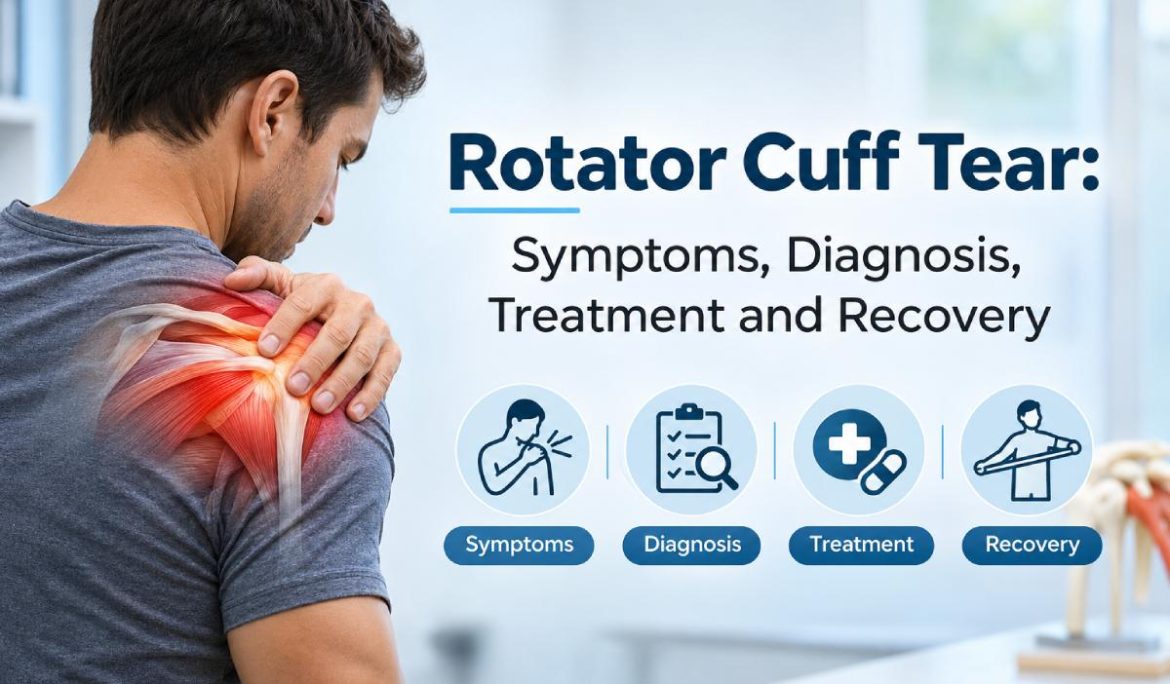
Shoulder pain can make everyday activities surprisingly difficult. Lifting a bag, reaching for something on a shelf, getting dressed, or sleeping on one side may become uncomfortable. Some people also notice weakness when lifting their arm or pain that travels from the shoulder towards the upper arm.
One possible cause is a rotator cuff tear, an injury involving one or more of the tendons that help move and stabilise the shoulder. A tear may occur suddenly after a fall or lifting injury, or it may develop gradually as the tendon changes with age and repeated use.
However, not every painful shoulder has a rotator cuff tear, and not every tear causes symptoms. Shoulder pain can also arise from tendon inflammation, bursitis, arthritis, instability, neck problems, and other conditions. Understanding the symptoms, how the diagnosis is made, and which treatment options are appropriate can help you make informed decisions about your shoulder health.
This guide explains rotator cuff tear symptoms, the difference between acute and degenerative tears, clinical examination, imaging, non-surgical treatment, rotator cuff repair, and recovery expectations.
What Is a Rotator Cuff Tear?
The rotator cuff is a group of four muscles and their tendons that surround the shoulder joint. These structures help lift and rotate the arm and keep the head of the upper-arm bone, called the humerus, appropriately positioned within the shoulder socket.
The four rotator cuff muscles are:
- Supraspinatus: Helps initiate lifting the arm away from the body.
- Infraspinatus: Helps rotate the arm outward.
- Teres minor: Assists outward rotation and shoulder stability.
- Subscapularis: Helps rotate the arm inward.
A rotator cuff tear occurs when one or more of these tendons become partially or completely torn. The supraspinatus tendon is commonly involved, although other tendons can also be affected.
The severity of a tear varies. Some tears involve only a small portion of a tendon, while others extend through its full thickness or involve more than one tendon.
What is the difference between a partial and a full-thickness tear?
A partial-thickness tear damages part of the tendon without completely passing through its thickness. Some tendon fibres remain intact. A full-thickness tear extends through the entire thickness of the tendon. Depending on its size and severity, the tendon may be detached partly or more extensively from its attachment to the upper-arm bone.
The size, location, and quality of the remaining tendon tissue can influence treatment decisions. However, the term “full-thickness tear” does not automatically mean that every patient needs surgery. The doctor must also consider symptoms, weakness, functional limitations, the cause of the injury, general health, and the patient’s activity requirements.
What Causes a Rotator Cuff Tear?
Rotator cuff tears generally develop through two broad mechanisms: an acute injury or gradual tendon degeneration. Some patients have a combination of both.
1. Acute rotator cuff tear
An acute tear develops following a specific injury or sudden event.
Possible causes include:
- Falling onto an outstretched arm.
- Falling directly onto the shoulder.
- Lifting a heavy object with a sudden jerking movement.
- A sports injury involving forceful shoulder movement.
- An injury associated with a shoulder dislocation or fracture.
A person may experience sudden shoulder pain, a popping sensation, or immediate weakness. Raising the arm may become difficult, particularly when the tear is significant. An acute injury does not always produce a complete tear. The severity needs to be assessed rather than inferred from the amount of pain alone.
If shoulder pain and weakness begin suddenly after an injury, arrange a prompt medical assessment. Significant loss of arm function may require timely investigation to identify the injury and determine whether early treatment is appropriate.
2. Degenerative rotator cuff tear
A degenerative tear develops gradually as the tendon changes over time. Tendon tissue can become less resilient with age, and repeated loading may contribute to progressive damage.
Possible contributing factors include:
- Age-related changes in tendon structure.
- Repetitive overhead work or sports.
- Long-term shoulder loading.
- Previous shoulder injuries.
- Individual differences in tendon health and blood supply.
Symptoms may begin as mild discomfort when reaching overhead. Over time, the person may experience increasing pain, weakness, or difficulty with daily activities.
Some degenerative tears cause little or no pain and are discovered during imaging for another reason. An imaging finding must therefore be interpreted alongside the patient’s symptoms and examination.
3. Can a rotator cuff tear occur without a major injury?
Yes. Many tears develop gradually without a single obvious injury. A person may not realise that the tendon has changed until shoulder pain or weakness becomes noticeable. Sometimes a relatively minor movement triggers symptoms in a tendon that was already weakened.
The movement may have made an existing problem noticeable rather than being the sole cause. If pain develops suddenly on top of a history of shoulder discomfort, the doctor may consider whether an acute injury has occurred in a previously degenerative tendon.
Rotator Cuff Tear Symptoms: What Should You Look For?
Rotator cuff tear symptoms vary according to the tendon involved, the size of the tear, its cause, and the person’s activity level.
Common symptoms include the following.
1. Pain when lifting the arm
Pain may occur when raising the arm sideways or reaching overhead. Activities such as putting an object on a shelf, washing your hair, or reaching into a cupboard may become uncomfortable.
The pain may be felt around the front or side of the shoulder and can sometimes travel down the upper arm. Pain during arm elevation is common in several shoulder conditions, so it does not confirm a rotator cuff tear on its own.
2. Shoulder pain at night
Some people experience discomfort when lying on the affected shoulder. Pain may also interrupt sleep or make it difficult to find a comfortable position.
Night pain can occur with rotator cuff problems, but it may also arise from other shoulder conditions. Persistent night pain should be assessed in the context of the overall symptoms.
3. Weakness when lifting or rotating the arm
Weakness is an important symptom, particularly when it develops suddenly after an injury. You may find it difficult to lift an object, raise your arm to shoulder height, or rotate the arm against resistance. The arm may feel less reliable during ordinary activities.
Pain can also inhibit muscle effort, making the shoulder feel weak even when the tendon is not completely torn. A clinical examination helps distinguish pain-related limitation from other causes of weakness.
4. Difficulty with everyday activities
A rotator cuff problem may affect activities such as:
- Combing or washing your hair.
- Reaching behind your back.
- Putting on a shirt or jacket.
- Lifting a shopping bag.
- Reaching overhead.
- Performing repetitive tasks at work.
- The degree of difficulty depends on the affected tendon, the tear, and the demands placed on the shoulder.
5. A popping or snapping sensation
Some people notice a pop when the injury occurs. Others experience clicking, grinding, or crackling during shoulder movement. These sensations are not specific to rotator cuff tears.
They may also occur with tendon irritation, bursitis, joint changes, or other shoulder problems. A sudden pop accompanied by significant pain and immediate weakness is more concerning than painless clicking that has been present for a long time.
6. Reduced shoulder movement
Pain and weakness can make it difficult to raise or rotate the arm. Some patients also develop stiffness, particularly if they avoid moving the shoulder for an extended period. Restricted movement may occur with a rotator cuff tear, but other conditions-such as frozen shoulder or arthritis-can produce similar symptoms.
The doctor will assess both active movement, where you move the arm yourself, and passive movement, where the examiner moves it while you relax as much as possible.
Can a rotator cuff tear occur without pain?
Yes. Some tears are discovered incidentally during imaging, particularly as people get older. This is one reason why an MRI finding alone does not establish that the tear is responsible for a person’s symptoms. The examination must consider whether the location and nature of the tear match the patient’s pain, weakness, and functional limitations.
Rotator Cuff Tear vs Rotator Cuff Tendinitis: What Is the Difference?
A rotator cuff tear involves a disruption of tendon fibres. Tendinitis or tendinopathy refers to a painful tendon condition that does not necessarily involve a tear. These conditions can produce overlapping symptoms, including pain when lifting the arm, discomfort at night, and difficulty with overhead activities.
| Feature | Rotator cuff tear | Rotator cuff tendinopathy or tendinitis |
| What is affected? | Part of a tendon or the full tendon thickness | Tendon tissue affected by irritation or structural changes |
| How can it start? | Acute injury or gradual degeneration | Often repeated loading or gradual tendon changes |
| Pain | May occur during movement, at rest, or at night | Often aggravated by particular movements or loading |
| Weakness | May be prominent, particularly with a significant tear | May occur because of pain or reduced muscle function |
| Imaging | May show a partial or full-thickness tear | May show tendon changes without a tear |
| Treatment | Depends on tear characteristics and symptoms | Often begins with activity modification and rehabilitation |
The distinction cannot always be made from symptoms alone. A patient can also have tendinopathy and a tear at the same time.
How Is a Rotator Cuff Tear Diagnosed?
Diagnosis usually involves a medical history, physical examination, and, when appropriate, imaging. The purpose is not simply to identify whether a tendon is torn. The doctor also needs to determine how the finding relates to the symptoms, whether other shoulder structures are involved, and which treatment options are suitable.
Step 1: Medical history
The doctor may ask:
- When did the pain start?
- Was there a fall, lifting injury, or sudden movement?
- Did the shoulder become weak immediately?
- Is the pain worse at night?
- Can you raise your arm above shoulder level?
- Have you noticed clicking, swelling, or stiffness?
- Does the pain interfere with work, exercise, or sleep?
- Have you previously injured or treated the shoulder?
These questions help distinguish a sudden traumatic injury from a problem that has developed over time. The doctor may also ask about the patient’s occupation, sports, and usual activity level because these factors can influence treatment goals.
Step 2: Physical examination
The doctor examines the shoulder and may assess tenderness, swelling, movement, and strength.
Range of motion
The examiner checks how far the arm can move forward, sideways, and in rotation. Comparing active and passive movement can provide useful clues about the cause of the limitation.
Strength
Selected movements may be tested against resistance to assess the rotator cuff and surrounding muscles.
Specific examination manoeuvres
The doctor may use particular tests to assess the tendons and other shoulder structures. No single test is definitive in every patient, so the findings are interpreted together.
Other possible causes
The examination may include assessment of the neck, nerves, shoulder joint, and surrounding structures. Neck-related nerve irritation, arthritis, frozen shoulder, and other problems can cause pain or weakness that resembles a rotator cuff injury.
Step 3: X-ray
An X-ray is often used to assess the bones and joints. It may help identify arthritis, fractures, bone spurs, or other abnormalities.
An ordinary X-ray does not show a rotator cuff tendon tear directly. However, it can help identify other explanations for shoulder symptoms and contribute to the overall assessment.
Step 4: Ultrasound
Ultrasound can help assess rotator cuff tendons and identify some partial or full-thickness tears. It may also provide information about surrounding soft tissues.
Its usefulness depends partly on the equipment and the experience of the person performing and interpreting the examination. It may be a suitable option when a focused tendon assessment is needed.
Step 5: MRI
An MRI can provide detailed information about the rotator cuff tendons, the extent of a tear, surrounding muscles, and other soft tissues. It may be useful when the diagnosis remains uncertain, a significant tear is suspected, or the information will help plan treatment or surgery.
MRI is not necessary for every patient with shoulder pain. The doctor decides whether it is appropriate based on the clinical assessment and the question that needs answering.
Does an MRI always mean surgery is required?
No. Imaging helps describe the structural problem; it does not make the treatment decision by itself. A tear may be present without causing significant symptoms. In other cases, a smaller tear may cause substantial pain or functional difficulty.
The decision depends on the patient’s symptoms, the physical examination, the tear’s characteristics, activity requirements, overall health, and treatment goals.
Rotator Cuff Injury Treatment: What Are the Options?
Rotator cuff injury treatment depends on the nature of the injury and how much it affects daily function. Many patients can begin with non-surgical treatment, while selected tears may benefit from surgical repair. The goal is to reduce pain, restore useful movement and strength, and help the patient return to appropriate activities.
1. Activity modification
Temporarily reducing movements that aggravate the shoulder may help control symptoms. This may mean limiting repetitive overhead work, heavy lifting, or painful gym exercises while the shoulder is assessed and treated.
Activity modification does not mean keeping the shoulder completely immobile for a prolonged period. Unnecessary immobilisation can contribute to stiffness and loss of strength. The right balance depends on the severity of the injury and the clinician’s advice.
2. Physiotherapy and rehabilitation
Physiotherapy is a central part of treatment for many rotator cuff problems. A tailored programme may include exercises to maintain or restore shoulder movement, improve the strength of surrounding muscles and develop better control of the shoulder during daily activities.
The programme should match the condition. Exercises suitable for uncomplicated tendon pain may not be appropriate immediately after a significant acute tear or following surgical repair. If a movement causes sharp pain or a marked increase in symptoms, stop and ask the treating clinician whether the exercise should be modified.
3. Medication for pain
A doctor may recommend suitable pain-relieving or anti-inflammatory medication depending on the patient’s symptoms, medical history and other medicines. These medicines can help manage symptoms, but they do not directly reconnect a torn tendon to the bone.
Some medications are unsuitable for people with certain stomach, kidney, cardiovascular or other health problems. Ask a qualified clinician or pharmacist before using them, particularly if you take regular medication.
4. Cold packs and short-term symptom management
A cold pack wrapped in a towel may help relieve discomfort after an activity or injury. Apply it for a short period and avoid placing ice directly on the skin.
If the shoulder is severely painful after an injury or there is sudden loss of arm function, do not rely on home measures alone. Arrange prompt medical assessment.
5. Injections in selected cases
A clinician may consider an injection when pain is limiting sleep, daily activities, or participation in rehabilitation. The type of injection, expected benefit and possible risks depend on the condition and the patient’s circumstances. Relief may be temporary, and an injection does not repair a torn tendon.
Repeated or poorly timed corticosteroid injections may have disadvantages, including potential effects on tendon tissue. If surgery is being considered, discuss any previous or proposed injection with the treating orthopaedic surgeon.
When Is Rotator Cuff Repair Surgery Considered?
Rotator cuff repair may be considered when the expected benefits of surgery outweigh its risks and limitations. The decision is individual. A tear on an MRI does not automatically require an operation, and non-surgical treatment is not necessarily appropriate for every significant tear.
Factors that may support considering repair include:
- A recent traumatic tear associated with substantial weakness or loss of function.
- Persistent pain despite an appropriate course of non-surgical treatment.
- Significant weakness that interferes with work or daily activities.
- A tear in a patient whose work or sport requires sustained overhead function.
- Tear characteristics and tendon quality that make repair a reasonable option.
The doctor may also consider the patient’s age, overall health, activity level, goals, and ability to complete postoperative rehabilitation.
For some acute traumatic tears, particularly when weakness is substantial, early specialist assessment is important because delay may affect the options available. This does not mean that every acute tear requires immediate surgery.
What happens during rotator cuff repair?
The purpose of repair is to reattach the torn tendon to its attachment on the upper-arm bone when the tear is suitable for repair. The procedure may be performed arthroscopically using a small camera and specialised instruments inserted through small incisions.
Some tears require an open or combined approach, depending on their characteristics and the surgeon’s assessment. During the operation, the surgeon examines the tendon and surrounding structures, assesses the tear, and performs the repair using an appropriate technique.
The exact procedure depends on the size and pattern of the tear, tendon quality, and other findings. After surgery, the repair needs protection while the tendon heals. Rehabilitation is carefully progressed rather than starting with unrestricted shoulder use. Learn more about arthroscopic surgery and discuss the appropriate procedure with an orthopaedic specialist.
Do all full-thickness tears need surgery?
No. Some full-thickness tears can be managed without surgery when pain and function respond adequately to non-surgical treatment and the patient’s goals can be met.
However, some tears may enlarge over time, and persistent weakness or functional limitation may make repair worth considering. The decision should be based on the complete clinical picture, not the tear classification alone.
Can a torn rotator cuff heal without surgery?
A torn tendon does not necessarily reconnect to the bone on its own. However, many patients improve in pain and function without surgical repair. Rehabilitation can help the remaining rotator cuff and surrounding muscles support shoulder movement. Activity modification and appropriate symptom management may also improve daily function.
This distinction is important: improvement in symptoms and function does not always mean the tendon has structurally healed. Follow-up should be guided by symptoms, examination, and the clinician’s advice.
Rotator Cuff Tear Recovery: What Should You Expect?
Rotator cuff tear recovery varies considerably. It depends on whether the injury is treated without surgery or with surgical repair, as well as the tear’s severity, the patient’s health, and the demands of daily activities. There is no single timeline that applies to every patient.
Recovery with non-surgical treatment
When treatment does not involve surgery, the initial focus is often on reducing aggravating activities and controlling pain. A rehabilitation programme may then progress through restoring movement, improving strength and increasing tolerance for daily activities.
Some patients notice improvement over several weeks. Others require a longer period of rehabilitation, and some continue to experience weakness or pain despite appropriate treatment. If symptoms persist, worsen, or continue to restrict normal activity, the diagnosis and treatment plan may need to be reviewed.
Recovery after rotator cuff repair surgery
Surgical recovery is usually longer because the tendon needs time to heal at its attachment to the bone. The following phases are general examples, not a substitute for the surgeon’s rehabilitation protocol.
Early phase: approximately the first 4–6 weeks
A sling is commonly used for a period determined by the surgeon. Its purpose is to protect the repair while healing begins. Some patients are allowed gentle passive shoulder movement under supervision, while active movement and lifting may be restricted. The timing depends on the repair, tear characteristics, and associated procedures.
Intermediate phase: approximately 6–12 weeks
If healing and the clinical assessment permit, rehabilitation may progress towards more active movement. The patient may gradually work on improving range of motion while continuing to protect the repair.
Progression should follow the treating team’s instructions. Reaching a particular week on the calendar does not automatically mean that lifting or unrestricted exercise is safe.
Strengthening phase: approximately 3–6 months
Strengthening may be introduced or progressed as the tendon heals and shoulder movement improves.
The exercises become more demanding only when the repair and the patient’s function allow. Heavy lifting, forceful overhead activity, and strenuous gym exercises may still be restricted.
Later recovery: approximately 6–12 months
Some patients need several additional months to regain strength, endurance, and confidence for demanding work or sport. Recovery may be slower after larger tears, repairs involving multiple tendons, or when there are other shoulder problems.
Some people do not regain the same function they had before the injury. Your surgeon and physiotherapist should guide the timing of return to driving, work, swimming, gym training, and sports.
What affects rotator cuff tear recovery?
Several factors can influence the recovery process:
- Tear size and pattern: Larger or more complex tears may require more extensive treatment.
- Tendon and muscle quality: Degenerative changes or muscle wasting can influence treatment choices and repair outcomes.
- Age and general health: Overall health can affect healing and rehabilitation.
- Smoking: Smoking can adversely affect tissue healing.
- Associated conditions: Arthritis, stiffness, or other shoulder problems may influence progress.
- Rehabilitation: Appropriate, consistent rehabilitation supports recovery, but exercises must not place excessive stress on a healing repair.
- Activity requirements: Returning to heavy manual work or overhead sport may take longer than resuming light daily tasks.
Recovery should be judged by healing, strength, movement, and functional ability-not by pain relief alone.
What Can You Do to Support Shoulder Recovery?
If you have shoulder pain or a diagnosed rotator cuff injury, these general measures may help support a safe treatment plan.
Follow the recommended activity restrictions
Avoid repeatedly forcing painful overhead movements or lifting heavy objects until you understand the injury and the appropriate limits.
Follow a tailored rehabilitation programme
Do not copy exercises from another patient or start strengthening a suspected acute tear without appropriate advice.
Attend follow-up appointments
These visits help the clinician review symptoms, movement and progress, and decide whether additional assessment is required.
Discuss your work and activity goals
If your job involves lifting, painting, construction, overhead work, or repetitive shoulder movements, tell your doctor. These demands can affect treatment decisions and return-to-work planning.
Avoid smoking where possible
Smoking can adversely affect tissue healing. Ask for support if you want to stop.
Do not ignore worsening weakness
Increasing difficulty raising the arm or a sudden deterioration after an injury should be reassessed.
When Should You See an Orthopaedic Doctor for Shoulder Pain?
Arrange an assessment if shoulder pain persists, repeatedly interrupts sleep, limits everyday activities, or is accompanied by weakness that does not improve. An earlier assessment is particularly important when pain and weakness begin after a fall, sudden lifting injury, or other traumatic event.
Seek urgent medical care if the shoulder appears deformed after an injury, you cannot move the arm following significant trauma, or you develop new numbness, a cold or discoloured hand, or severe and rapidly increasing pain.
Shoulder pain with chest discomfort, breathlessness or sweating may have a cause unrelated to the shoulder and needs emergency assessment. An orthopaedic doctor can help establish whether the problem involves the rotator cuff, another shoulder structure or a condition originating elsewhere.
Frequently Asked Questions About Rotator Cuff Tears
1. What are the first signs of a rotator cuff tear?
Early symptoms may include pain when lifting the arm, discomfort at night, weakness during overhead activities, or difficulty reaching behind the back. Some tears cause few symptoms, and these signs are not specific enough to confirm a tear without assessment.
2. Can I move my arm if I have a rotator cuff tear?
Yes, some people with a tear can still move their arm, particularly if the tear is small or other muscles compensate for the affected tendon. A significant tear may cause considerable weakness or loss of function. The ability to move the arm does not rule out an injury.
3. Is a rotator cuff tear the same as a shoulder tendon tear?
A rotator cuff tear is one type of shoulder tendon tear. Other tendons around the shoulder, including the biceps tendon, can also be injured. The affected tendon must be identified because the diagnosis and treatment may differ.
4. Can a rotator cuff tear cause pain at night?
Yes. Some people experience pain when lying on the affected shoulder or during sleep. Night pain can also occur with other shoulder conditions, so it should be considered alongside the rest of the symptoms.
5. Does a rotator cuff tear always need surgery?
No. Many patients can improve with activity modification, medication when appropriate, and physiotherapy. Surgery may be considered for selected acute tears, persistent symptoms, substantial weakness, or particular activity requirements.
6. Can physiotherapy help a rotator cuff tear?
Physiotherapy can improve movement, strength and function in many patients. It does not necessarily reconnect a torn tendon to the bone. The programme must be adapted to the injury and should protect a repair if surgery has been performed.
7. Does a full-thickness rotator cuff tear always require repair?
No. The treatment decision depends on symptoms, weakness, tear characteristics, tendon quality, activity requirements, and overall health. Some patients can function well without surgery, while others may benefit from repair.
8. Is MRI necessary to diagnose a rotator cuff tear?
Not in every case. A doctor may use the history and physical examination to guide the initial assessment. X-rays, ultrasound, or MRI may be recommended when imaging is likely to clarify the diagnosis or change treatment planning.
9. How long does rotator cuff tear recovery take?
Recovery depends on the severity of the tear and the treatment used. Some patients improve over several weeks or months with non-surgical treatment. Following surgery, recovery often takes several months, and demanding activities may require 6–12 months or longer depending on healing and rehabilitation.
10. Can a rotator cuff tear get bigger over time?
Some tears, particularly degenerative tears, may enlarge over time. Worsening pain or increasing weakness should be reviewed by a clinician. Not every tear progresses in the same way, and individual follow-up depends on symptoms and clinical findings.
11. Can I exercise with a rotator cuff tear?
The answer depends on the tear and the symptoms. Some exercises are useful as part of a supervised rehabilitation programme, while heavy lifting and painful overhead movements may need to be limited. Obtain advice before beginning or progressing shoulder exercises, especially after an acute injury or surgery.
12. When can I return to the gym after rotator cuff repair?
Return to gym training depends on the repair, healing progress, strength, and the type of exercise. Lower-body activity may have different restrictions from upper-body lifting, but even apparently unrelated exercises must be performed safely. Your surgeon or physiotherapist should confirm when each activity can resume.
Conclusion: Choosing the Right Treatment for a Rotator Cuff Tear
A rotator cuff tear can cause shoulder pain, weakness, night discomfort, and difficulty with everyday activities. It may develop suddenly after an injury or gradually as the tendon changes over time. The diagnosis depends on the medical history, physical examination, and appropriate imaging.
Treatment may involve activity modification, pain management, and physiotherapy, while selected tears may benefit from surgical repair. Not every tear requires surgery, and not every patient with shoulder pain has a tear. The decision should reflect the symptoms, tear characteristics, functional needs, and likely benefits and risks of each treatment option.
If shoulder pain persists, weakness develops, or symptoms begin after an injury, consult an orthopaedic specialist for an assessment. A clear diagnosis and an individualised plan can help you understand your options and work towards the best achievable shoulder function.
About Dr. Tushar Kadam
Dr. Tushar Kadam is an orthopaedic surgeon in Thane. Patients experiencing persistent shoulder pain or weakness can seek an orthopaedic assessment to discuss possible causes, diagnostic findings, and suitable treatment options. Learn more about his qualifications and clinical services on the official website and in the About Dr. Tushar Kadam section.
Medical disclaimer: This article is intended for general education and does not replace a medical assessment. Diagnosis, treatment decisions, and rehabilitation should be guided by a qualified healthcare professional.