

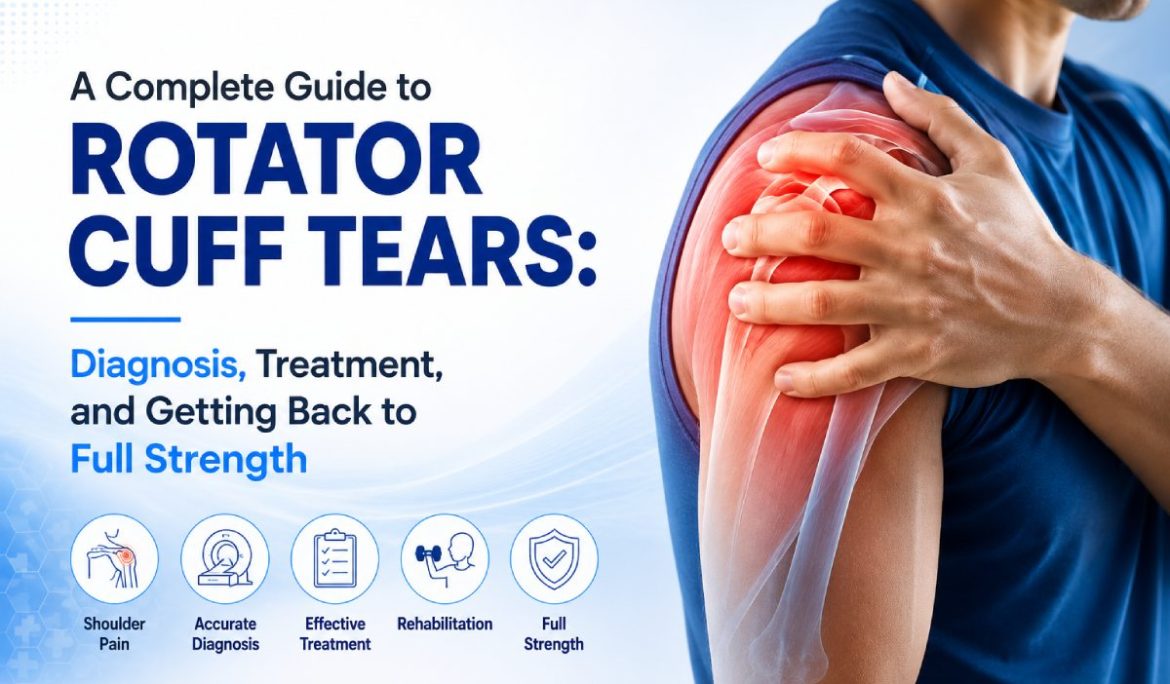
That Shoulder Pain Keeping You Up at Night?
You notice it first while reaching up to a shelf. Then again when you try to swing a racket. By evening, the shoulder aches even at rest, and when you finally lie down to sleep, the rotator cuff pain at night wakes you every time you roll onto that side. Shoulder pain is one of the most common musculoskeletal complaints among adults in India. And among all the possible causes, a rotator cuff tear is one of the most frequently missed, most frequently undertreated, and most commonly misunderstood.
Many patients in Thane and Mumbai spend months managing shoulder pain with hot packs, pain gel, and the occasional painkiller, not realising that the underlying tendon damage is silently getting worse. By the time they reach a specialist, a tear that could have been treated conservatively or with simple keyhole surgery has grown into something far more complex. If you are searching for the best orthopedic surgeon for rotator cuff near me, recognising these early warning signs can help you seek timely treatment before the condition progresses.
This article is designed to change that. Whether you are a badminton player who felt a pop during a smash, an office professional whose shoulder has been aching for months, or a manual worker who can no longer lift their arm overhead, this guide explains what is happening in your shoulder, what the options are, and what you should do next. Consulting experienced rotator cuff surgeons near me at the right time can make a significant difference in preserving shoulder strength and function.
What Is the Rotator Cuff? Understanding the Anatomy
The rotator cuff is not a single structure; it is a group of four muscles and their tendons that surround and stabilise the shoulder joint. Think of them as the shoulder’s dynamic seat belt system.
| Muscle | Primary Function | Commonly Injured In |
| Supraspinatus | Initiates arm elevation (0-15 degrees) | Most commonly torn; overhead activity, falls |
| Infraspinatus | External rotation of the arm | Throwing athletes, badminton, tennis |
| Teres Minor | External rotation, stabilisation | Less commonly injured in isolation |
| Subscapularis | Internal rotation; front of shoulder | Contact sport, heavy pushing, falls |
The supraspinatus tendon is by far the most commonly torn, running through a narrow channel between the ball of the shoulder and the roof of the shoulder blade (acromion). It is under load almost every time you lift your arm, which explains why supraspinatus tears are so debilitating.
| Types of Rotator Cuff Tears at a Glance
Partial thickness tear: The tendon is frayed or damaged but not completely through. Ranges from a small surface defect to nearly full depth. Conservative treatment often works well. Full thickness tear: The tendon is torn completely through. This can be a small puncture or a massive tear involving multiple tendons. Surgery is more commonly indicated. Massive rotator cuff tear: Involves two or more tendons, often with tendon retraction and muscle wasting. Surgical complexity increases significantly. Early diagnosis prevents this outcome. |
Causes and Risk Factors: Why Do Rotator Cuff Tears Happen?
Rotator cuff tears fall into two broad categories: acute (sudden) and degenerative (gradual). Understanding which type you have is important because it influences treatment decisions.
Acute Tears- Sudden Injury
- A fall onto an outstretched arm or directly onto the shoulder
- A forceful pull or lift such as catching a heavy object or a sudden jerk of the arm
- A direct blow to the shoulder during contact sport, kabaddi, wrestling, or a cricket fielding collision
- A badminton or tennis smash where the shoulder is loaded at maximum speed
- A shoulder dislocation, particularly in patients over 40; dislocation frequently causes a rotator cuff tear simultaneously
Degenerative Tears: Gradual Wear
- Repeated overhead activity over years: painting, construction work, warehouse lifting, swimming, throwing
- Age-related tendon degeneration: the vascularity and collagen quality of the supraspinatus tendon declines significantly from the 40s onward
- Shoulder impingement syndrome: left untreated, the tendon is repeatedly pinched under the acromion until it eventually tears
- Bone spur (osteophyte) under the acromion acts like a knife edge on the tendon with every arm lift
Who Is at Highest Risk?
| Risk Group | Why They Are Vulnerable |
| Adults over 40 | Tendon blood supply and quality decline; degeneration accelerates |
| Badminton, tennis & cricket players | Repeated high-speed overhead arm movement loads the supraspinatus |
| Construction workers & painters | Sustained overhead work for hours daily |
| Gym-goers using heavy overhead loads | Military press, lat pulldown, and bench press with poor form |
| People with prior shoulder impingement | Unresolved impingement is the precursor to many degenerative tears |
| Smokers | Poor tendon vascularity, impaired healing, and accelerated degeneration |
| Those with previous shoulder dislocation | Especially over 40; dislocation commonly co-occurs with rotator cuff tear |
Symptoms: How Does a Rotator Cuff Tear Feel?
The symptoms of a rotator cuff tear vary considerably depending on whether it is acute or degenerative, partial or full thickness. Some people with significant tears have surprisingly mild symptoms for months before the pain intensifies. Recognising these symptoms early and consulting a rotator cuff doctor near me can help prevent further tendon damage and improve treatment outcomes.
Common Symptoms
- Shoulder pain with overhead activity reaching up to a shelf, combing hair, putting on a shirt, serving in badminton
- Night pain is one of the most characteristic features; pain that wakes you when rolling onto the affected shoulder
- Weakness when lifting the arm to the side or forward
- A painful arc of movement typically between 60–120 degrees of arm elevation
- A clicking, catching, or grinding sensation during shoulder movement
- Difficulty with specific activities: throwing, reaching behind the back, or any sustained overhead task
Symptoms That Suggest a More Serious Tear
- Inability to raise the arm at all; the arm hangs limply (drop arm sign in massive tears)
- Severe sudden weakness immediately after an injury suggests acute full-thickness tear
- Visible muscle wasting above or behind the shoulder blade (supraspinous or infraspinous fossa atrophy)
- Shoulder pain that does not improve despite 6–8 weeks of rest and physiotherapy
| Do Not Ignore These Red Flags
Sudden inability to lift the arm after a fall or injury, severe rotator cuff pain at night that is getting progressively worse over weeks, visible wasting of the shoulder muscles, or a shoulder that feels completely unstable should prompt an urgent orthopaedic review. These patterns suggest a significant full-thickness or massive tear where delay significantly worsens surgical outcomes. Seeking advice from experienced shoulder experts near me can help ensure timely diagnosis and the most appropriate treatment. |
Diagnosis: How Is a Rotator Cuff Tear Identified?
A rotator cuff tear cannot be reliably diagnosed on X-ray alone. It requires a combination of clinical examination and appropriate imaging. If you are searching for a rotator cuff doctor near me, ensure they perform a thorough clinical assessment along with the appropriate imaging to accurately diagnose the extent of the injury.
Clinical Examination Tests
- Empty can test (Jobe’s test)- The arm is held at 90 degrees, tilted forward, and the patient resists downward pressure from the examiner. Pain or weakness suggests supraspinatus involvement
- External rotation lag sign- The examiner passively externally rotates the arm; if the patient cannot hold this position, a significant infraspinatus tear is likely
- Lift-off test- Assesses the subscapularis specifically; the patient tries to lift their hand off the lower back against resistance
- Drop arm test- The patient lowers their arm slowly from full elevation; inability to do this smoothly suggests a significant tear
- Painful arc- Pain specifically between 60 and 120 degrees of abduction is strongly suggestive of supraspinatus pathology
- Hawkins- Kennedy test and Neer’s sign – Tests for associated shoulder impingement
Imaging Investigations
| Investigation | What It Shows | Limitations |
| X-ray (shoulder series) | Bone spurs, AC joint arthritis, signs of chronic tear (superior migration of humeral head) | Cannot directly visualise tendons or cartilage |
| Ultrasound (dynamic) | Rotator cuff tendon tears, thickness, retraction; real-time assessment | Operator-dependent; limited for deep structures |
| MRI of shoulder | Gold standard: tear size, retraction, muscle quality, labrum, cartilage | Expensive; claustrophobia; not available everywhere |
| MR Arthrogram | Partial tears, labral pathology; dye injected before scan | Invasive; used in specific diagnostic questions |
| CT scan | Bone anatomy, acromion morphology; pre-surgical planning | Radiation; limited soft tissue detail |
MRI is the investigation of choice for rotator cuff tears. It tells the surgeon not just whether a tear exists, but its size, how far the tendon has retracted, and critically the quality of the muscle. Fatty infiltration of the muscle (muscle being replaced by fat over time) significantly affects both surgical candidacy and outcomes. Patients looking for the best orthopedic surgeon for rotator cuff near me are often advised to undergo an MRI to help determine the most effective treatment plan.
Treatment Options: Conservative vs. Surgical
The treatment of a rotator cuff tear is not one-size-fits-all. Age, tear size, muscle quality, the patient’s functional demands, and duration of symptoms all factor into the decision. Here is a structured overview. If you are considering the best orthopedic surgeon for rotator cuff near me, an individualised treatment plan based on your condition is essential for achieving the best outcome.
Conservative (Non-Surgical) Treatment
For partial-thickness tears, small full-thickness tears in older or less active patients, and degenerative tears in patients without significant weakness, a well-structured non-surgical programme often achieves excellent results.
Activity Modification
- Reduce overhead activities temporarily, particularly those that reproduce pain
- Modify gym training: avoid overhead press, wide-grip bench press, lateral raises above 90 degrees
- Continue lower body and core training to maintain fitness while avoiding movements that aggravate the shoulder until your rotator cuff workout can be safely resumed.
Physiotherapy
A structured physiotherapy programme focuses on: strengthening the intact rotator cuff muscles to compensate for the torn tendon, improving scapular stability, reducing impingement, and gradually restoring range of motion and strength. Carefully supervised rotator cuff exercises are a key part of rehabilitation and help restore shoulder function safely.
Anti-Inflammatory Medication and Injections
- NSAIDs (short-term use) to manage acute pain and enable physiotherapy
- Corticosteroid injection into the subacromial space reduces inflammation and allows pain-free physiotherapy. Limited to 1–2 injections as repeated use can further weaken tendon tissue
- PRP (Platelet-Rich Plasma) injection increasingly used for partial tears; promotes tendon healing through biological growth factors. Better long-term profile than steroids for tendon health
Surgical Treatment: Arthroscopic Rotator Cuff Repair
Surgery is generally recommended for: full-thickness tears causing significant weakness or functional limitation; acute traumatic tears in active patients; tears that have failed 3-6 months of conservative treatment; and younger patients (under 60) where long-term outcomes are better with repair. Choosing the best rotator cuff surgeons near me ensures proper evaluation and timely intervention when surgery is indicated.
What the Surgery Involves?
Rotator cuff repair is performed arthroscopically through 3-4 small (1 cm) incisions around the shoulder. A camera and small instruments are used to reattach the torn tendon back to the bone using suture anchors (small titanium devices that hold the tendon firmly to the humeral head while it heals).
- Anaesthesia: General with a nerve block for post-operative pain control
- Duration: 60 min to 2 hours depending on tear complexity
- In hospital stay: day care surgery in some cases and 1 night stay in others
- Bone anchors are permanent and do not require removal
Find out more about Arthroscopic Rotator cuff repair in our surgical treatments section
When Is Surgery Not Possible?
Massive tears with severe muscle wasting (fatty infiltration Grade 3-4) may not be repairable because the muscle cannot generate enough tension to hold the repair. In these cases, alternatives include partial repair, biceps tenodesis, superior capsular reconstruction, or a reverse total shoulder replacement for older patients with significant arthritis. Consulting experienced rotator cuff surgeons near me in Mumbai, Navi Mumbai, and Thane helps determine the most suitable option based on tear severity and muscle quality.
Conservative vs. Surgical Treatment: A Practical Comparison
| Factor | Conservative Treatment | Arthroscopic Surgery |
| Best for | Partial tears, small full tears, older/inactive patients | Full-thickness tears, failed conservative Rx, young active patients |
| Recovery time | 3–6 months | 6 – 12 months |
| Return to sport | 3–6 months (modified activity earlier) | 6 – 12 months |
| Risk of tear progression | Yes, untreated tears can enlarge over time | Minimal repaired tendon heals to bone |
| Success rate | Good for partial tears and low-demand patients | 85–95% in well-selected patients |
| Anaesthesia required | No | Yes |
| Key limitation | Tear may enlarge; not suitable for large/massive tears | Longer recovery; fatty infiltration limits repair |
Recovery: What to Expect After Rotator Cuff Repair
Recovery from rotator cuff surgery is one of the longest in orthopaedic practice. This is not because the surgery is particularly invasive it is keyhole. It is because the repaired tendon takes time to heal back to bone, and rushing this process results in re-tears.
| Phase | Timeframe | Key Milestones |
| Immobilisation | Week 0-6 | Arm in a sling at all times. Pendulum exercises only. Elbow, wrist, hand movement maintained. |
| Early motion | Week 6-12 | Sling weaned off. Passive range of motion begins. No active lifting. |
| Active strengthening | Month 3-6 | Active range of motion restored. Rotator cuff strengthening programme begins using guided rotator cuff exercises. |
| Functional return | Month 4-6 | Return to desk work, light activity, non-overhead gym exercises. |
| Sport-specific rehab | Month 6-9 | Return to swimming, non-contact sport, overhead lifting and progressive rotator cuff workout routines under supervision. |
| Full sport return | Month 9-12 | Contact sport, overhead racquet sport, unrestricted gym activity. |
The most common reason for failed rotator cuff surgery is not technical; it is inadequate rehabilitation or premature return to activity. A properly supervised physiotherapy programme is as important as the surgery itself.
Exercises: Rehabilitation for Rotator Cuff Injuries
These exercises are appropriate for the early rehabilitation phase (for conservative management or post-surgery after physiotherapist clearance). Do not begin strengthening exercises without medical guidance if you have had surgery.
1. Pendulum Exercise (Early Phase)
Lean forward, supporting yourself with the unaffected arm on a table. Allow the affected arm to hang freely. Use gentle body movement to create small circular motions of the hanging arm. This encourages fluid movement and prevents stiffness without active muscle contraction. 2 minutes, 3 times daily. These gentle rotator cuff exercises are commonly recommended during the initial phase of recovery.
2. Scapular Retraction (Safe at Any Stage)
Sit or stand upright. Gently squeeze the shoulder blades together and hold for 5 seconds. Release slowly. 3 sets of 15 repetitions. This activates the periscapular muscles that support the rotator cuff without loading the torn tendon.
3. External Rotation with Band (Later Phase, Surgeon/Physio Cleared)
Stand with the elbow at 90 degrees, upper arm against the body. Hold a light resistance band and rotate the forearm outward slowly. Hold 2 seconds. Return slowly. 3 sets of 15 repetitions. Strengthens the infraspinatus and teres minor without overhead loading and is an effective rotator cuff workout once approved by your physiotherapist.
4. Side-Lying External Rotation
Lie on the unaffected side. Hold a light weight (0.5-1 kg). Elbow at 90 degrees, forearm resting on the abdomen. Slowly rotate the forearm upward. Lower slowly. 3 sets of 15 repetitions. One of the safest and most effective rotator cuff exercises for rebuilding shoulder strength.
Prevention: Protecting Your Rotator Cuff
- Strengthen your rotator cuff proactively- external rotation exercises with bands should be part of every gym-goer’s and overhead sport player’s routine. Regular rotator cuff exercises can significantly improve shoulder stability and reduce the risk of future injuries.
- Warm up the shoulder thoroughly before any overhead activity- badminton, cricket, swimming, or gym pressing
- Address shoulder impingement early- impingement left untreated is the most common cause of degenerative rotator cuff tears
- Avoid training through shoulder pain- particularly pain with overhead pressing or lateral raises
- Improve your technique in racquet sports- work with a coach to ensure efficient shoulder mechanics in your serve and smash
- Reduce sudden spikes in overhead training volume- the 10% weekly increase rule applies to shoulder training as much as it does to running. A gradual rotator cuff workout progression is always safer than a sudden increase in intensity.
- If you are over 40 and have shoulder pain that has lasted more than 4 weeks, get an MRI- early identification of partial tears prevents progression to full tears
When Should You See an Orthopaedic Surgeon?
Do not delay seeking specialist review for shoulder pain. Early diagnosis preserves your surgical options. If you have been searching for the best orthopedic surgeon for rotator cuff near me or experienced shoulder experts near me, these symptoms indicate that you should arrange an evaluation as soon as possible.
- Shoulder pain has persisted for more than 4-6 weeks despite rest and basic measures
- You cannot raise your arm above shoulder height, or raising it causes significant pain
- You have rotator cuff pain at night that wakes you or prevents you from sleeping on the affected side
- Shoulder weakness is affecting your work, sport, or daily activities
- You experienced a fall or sudden injury and have had pain and weakness since
- You have been told you have a rotator cuff tear on an ultrasound or MRI but have not yet seen a specialist
- You are an active individual under 60 with a known tear; the window for optimal repair narrows as tear size increases over time
Orthopaedic specialists in Thane, Navi Mumbai, Mulund, and Mumbai can perform a full clinical assessment, interpret your imaging, and give you a clear, honest recommendation on whether surgery is needed or whether a structured non-surgical approach is appropriate for your specific tear. Choosing experienced best rotator cuff surgeons near me in Mumbai, Navi Mumbai, and Thane can help ensure you receive the most appropriate treatment plan based on your condition and lifestyle.
Frequently Asked Questions (FAQ)
Can a rotator cuff tear heal on its own?
Partial thickness tears can sometimes stabilise and become asymptomatic with proper rehabilitation, though the structural damage does not fully reverse on its own. Full thickness tears, however, do not heal spontaneously. Without treatment, they typically enlarge over time. The question is whether a non-surgical approach (strengthening the remaining intact cuff) provides sufficient function for that patient’s needs, which for some patients, particularly older or less active individuals, it can.
How do I know if I have a rotator cuff tear or just a strain?
A strain (muscle pull) typically resolves within 2-4 weeks with rest. If shoulder pain persists beyond that, involves significant weakness when lifting the arm, causes rotator cuff pain at night, or worsens during overhead activity, a rotator cuff tear is far more likely. An MRI is the definitive way to tell. Do not assume it is ‘just a strain’ after 4-6 weeks of persistent symptoms.
Is surgery always needed for a rotator cuff tear?
No. Many rotator cuff tears, particularly small partial tears and some full-thickness tears in older or less physically active patients, can be managed successfully without surgery through physiotherapy and pain management. The decision depends on tear size, patient age, muscle quality on MRI, activity level, and response to conservative treatment. Your surgeon should give you an honest assessment of both options. Consulting rotator cuff surgeons near me can help you understand which treatment approach is best suited to your specific injury.
What happens if a rotator cuff tear is left untreated?
This depends on the tear type. Small tears in low-demand patients may remain stable for years. However, untreated full-thickness tears frequently enlarge over time. As the tear grows, the tendon retracts further from the bone, and the muscle undergoes fatty infiltration, a process where the muscle tissue is progressively replaced by fat. Once significant fatty infiltration occurs, the tear may no longer be repairable, meaning surgery options become limited to palliative rather than curative procedures.
How long is the recovery after rotator cuff surgery?
Recovery is longer than most patients expect. The sling is worn for 4-6 weeks. Active movement begins around 6-12 weeks. Return to desk work is possible at 3-4 months. Return to sport, particularly overhead sport like badminton or cricket, typically takes 9-12 months. The reason for this extended timeline is that the tendon heals back to bone through a biological process that cannot be safely rushed.
Can I play badminton or cricket after rotator cuff surgery?
Yes, in most cases. The goal of surgery in an active patient is precisely to restore the ability to participate in overhead sport. Most patients who have a successful repair and complete their full rehabilitation return to their pre-injury sport by 9–12 months. The key is patience with rehabilitation and not returning to sport before the tendon has adequately healed and strength has been restored.
What is the difference between a rotator cuff tear and shoulder impingement?
Shoulder impingement is the condition where the rotator cuff tendons are repetitively pinched between the ball of the shoulder and the roof (acromion) during overhead movement. Left untreated, ongoing impingement gradually wears through the tendon, leading to a rotator cuff tear. In other words, impingement is often the precursor. Treating impingement early is therefore also the best way to prevent degenerative rotator cuff tears.
Is a rotator cuff tear visible on X-ray?
Not directly. X-rays show bone, not soft tissue. However, certain X-ray findings suggest a rotator cuff tear indirectly: a bone spur under the acromion, narrowing of the space between the acromion and the humeral head (indicating the tendon has been lost), and calcification within the tendon. An MRI is the gold standard investigation to directly visualise the tear.
Will I need a full open surgery or can it be done by keyhole?
The vast majority of rotator cuff repairs in India and globally are now performed arthroscopically (keyhole surgery) through 3–4 small incisions, with a camera and miniaturised instruments. Open surgery is rarely required and is reserved for very specific revision or complex cases. Arthroscopic repair has equivalent or superior outcomes to open surgery, with faster recovery and lower complication rates. If you are looking for the best orthopedic surgeon for rotator cuff near me, choosing a surgeon experienced in arthroscopic techniques can improve both recovery and long-term outcomes.
Can PRP treatment help a rotator cuff tear?
PRP (Platelet-Rich Plasma) is most useful for partial thickness tears and as an adjunct to rehabilitation. It delivers concentrated growth factors to the damaged tendon, promoting tissue repair. For full-thickness tears, PRP alone cannot bridge a structural defect in the tendon; it may reduce pain and slow progression, but surgical repair remains the definitive treatment for symptomatic full-thickness tears in active patients. If conservative treatment is unsuccessful, consulting best rotator cuff surgeons near me or a trusted rotator cuff doctor near me can help determine whether surgical repair is the right option
| A Note from Our Practice
Shoulder pain is your body telling you something is wrong. For a rotator cuff tear specifically, the window for the best outcome, whether surgical or non-surgical, is time-sensitive. A small tear treated early often needs only conservative management. A large tear identified late may require complex surgery with a longer and more uncertain recovery. If your shoulder has been painful for more than a month, if you cannot raise your arm comfortably overhead, or if night pain is disrupting your sleep, it is time to get a proper assessment. Book a consultation today and get a clear answer about what is happening in your shoulder. |
This article is written for educational purposes and does not replace personalised medical advice. Please consult a qualified orthopaedic surgeon for diagnosis and treatment specific to your condition.