

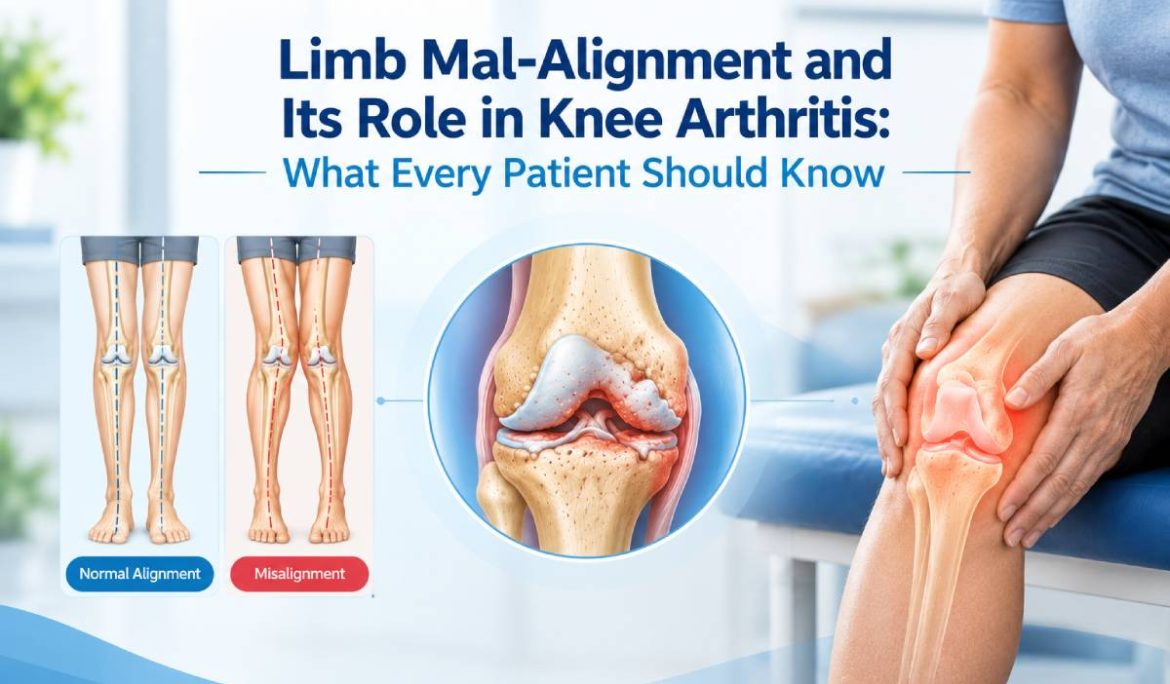
Look down at your legs while standing normally, feet together. Do your knees touch before your ankles do? Or is there a gap between your knees even when your ankles are touching? Most people have never really looked, but this one observation can explain years of unexplained knee pain.
We see this often in our clinic in Thane: a 45-year-old office-goer with knee pain only on one side, a homemaker in her 50s whose knee “just wore out early,” a former college athlete now struggling to squat comfortably. In a large number of these cases, the root cause isn’t simply “age” or “wear and tear.” It’s limb malalignment, a mismatch in how the leg’s bones line up, quietly overloading one part of the knee for years before arthritis sets in.
Understanding this single concept changes how we think about knee arthritis. It’s not always just about getting older. Sometimes, it’s about how your legs have been carrying your weight your entire life, and whether that can be corrected before the damage becomes permanent. This is the foundation of joint preservation principles in modern orthopaedics.
What Is Limb Mal-Alignment?
Imagine a straight line running from the centre of your hip, through the centre of your knee, down to the centre of your ankle. In a well-aligned leg, this line is almost straight, and your body weight passes evenly through the middle of the knee joint with every step.
Limb mal-alignment means this line is bent or shifted, either inward or outward at the knee. Instead of weight passing through the centre of the joint, it gets concentrated on one side. Over months and years, that one side of cartilage wears down much faster than the other, eventually leading to one-sided (compartmental) knee arthritis.
This is different from typical age-related arthritis, which tends to wear down the knee more evenly. Mal-alignment-driven arthritis is often lopsided, starts earlier in life, and is frequently seen in people who are otherwise fit and active. Recognizing the link between limb malalignment and knee arthritis is important because abnormal weight distribution can affect joint health even in physically active individuals.
Varus Knee and Valgus Knee: The Two Patterns of Mal-Alignment
There are two basic ways a knee can be malaligned, and they affect the joint in opposite ways.
| Feature | Varus Knee (Bow-Leg) | Valgus Knee (Knock-Knee) |
| Appearance | Knees bowed outward, ankles touch, but knees don’t | Knees angled inward, touching while ankles stay apart |
| Compartment overloaded | Inner (medial) side of the knee | Outer (lateral) side of the knee |
| How common it is | More common overall, especially with age-related wear | Less common, often linked to injury or ligament laxity |
| Typical arthritis pattern | Medial compartment osteoarthritis | Lateral compartment osteoarthritis |
| Associated correction surgery | High Tibial Osteotomy (HTO) | Distal Femoral Osteotomy (DFO) |
A valgus knee deformity angles the knee inward and can increase stress on the outer compartment of the joint. The severity and source of the deformity should be assessed before treatment is recommended.
Most people have a small, normal degree of varus or valgus angulation, this alone isn’t a problem. It becomes clinically significant when the angle is large enough to meaningfully shift load away from the centre of the joint, which is something your orthopaedic surgeon measures precisely on an X-ray, not just by eye.
How Limb Mal-Alignment Leads to Knee Arthritis
Cartilage, the smooth cushioning tissue inside your knee, is built to handle repeated load, but it’s designed for that load to be spread evenly. When mal-alignment concentrates your body weight onto one small area of cartilage, that area is essentially doing the work of the whole joint, step after step, year after year. Understanding the connection between limb malalignment and knee arthritis can help patients recognize why uneven pressure on the knee may contribute to cartilage damage over time.
The sequence usually looks like this:
- Malalignment shifts the weight-bearing line away from the centre of the knee
- One compartment (inner or outer) takes disproportionately more load with every step
- Cartilage in that compartment thins and wears down faster than the rest of the joint
- As cartilage thins, the malalignment often worsens further, creating a self-feeding cycle
- Over years, this leads to one-sided osteoarthritis, often well before the “usual” age for knee arthritis
This is exactly why two people the same age can have very different knee health – one with a well-aligned limb ages gracefully, while another with untreated mal-alignment develops significant arthritis a decade or two earlier.
Causes and Risk Factors for Limb Mal-Alignment
- Childhood growth patterns – some degree of bow-leg or knock-knee carried forward from growing years
- Old fractures around the knee or shin that healed in a slightly angled position
- Ligament injuries, especially long-standing or untreated ones, that gradually change how the knee sits
- Previous meniscus tears or meniscus surgery, which can alter joint mechanics over time
- Existing arthritis itself, which can worsen alignment as cartilage wears unevenly
- Obesity, which increases the mechanical stress on an already mal-aligned joint
- Occupational and lifestyle strain – prolonged standing, squatting, or floor-based work common among homemakers and labourers in India
- Inflammatory joint conditions such as rheumatoid arthritis, which can affect alignment, particularly on the outer side of the knee
Identifying the cause and severity of the deformity helps guide appropriate bow leg treatment or knock knee treatment, which may involve monitoring, symptom management, or corrective surgery in selected cases.
Symptoms and Warning Signs
Limb mal-alignment itself doesn’t always hurt – many people walk around for years with a mild bow-leg or knock-knee and no symptoms at all.
The warning signs usually appear once the overloaded compartment starts to wear down:
- Knee pain consistently on one side (inner or outer), rather than all over the joint
- Pain that worsens with walking, standing for long periods, or climbing stairs
- A visibly bowed or knock-kneed stance, sometimes more noticeable in old photographs over the years
- Uneven wear on the soles of your shoes, often on the inner or outer edge
- A feeling of the knee shifting or being unstable on uneven ground
- Swelling localized to one side of the knee after activity
- Gradually worsening stiffness, especially when getting up after sitting cross-legged or on the floor
If you’ve noticed one-sided knee pain along with a change in how your legs look while standing, it’s worth getting your alignment checked rather than just treating the pain symptomatically.
How Is Limb Mal-Alignment Diagnosed?
- Clinical assessment: your surgeon observes your standing posture, gait, and the visible angle of your knees.
- Weight-bearing X-rays: taken while standing, since alignment changes under load compared to lying down.
- Long-leg (hip-to-ankle) alignment X-ray: the gold-standard test that precisely measures the mechanical axis of the limb and confirms the degree of varus or valgus angulation.
- MRI: to assess how much cartilage damage has already occurred in the overloaded compartment.
- Gait analysis: in select cases, to understand how alignment affects your walking pattern and treatment planning.
Measuring the alignment also helps determine the extent of a valgus knee deformity and supports decisions about appropriate treatment. This is one of the most important featured-snippet facts for patients to know: alignment cannot be reliably assessed from a standing-knee X-ray alone; a full-length, hip-to-ankle X-ray is needed to measure it accurately.
Treatment Options: Joint Preservation Principles
The central idea behind joint preservation is simple: correct the mechanical problem early, before the cartilage damage becomes too advanced to reverse the trend. Treatment is chosen based on how much mal-alignment is present and how much cartilage damage has already occurred.
Early-stage, non-surgical management
- Weight management to reduce the load passing through the affected compartment
- Physiotherapy to strengthen the muscles that support and stabilise the knee
- Unloader braces, which mechanically shift some load away from the overloaded side
- Footwear modifications, such as lateral or medial wedge insoles in select cases
- Activity modification to reduce high-impact strain while staying active in lower-impact ways
Surgical joint preservation: Osteotomy
When limb mal-alignment is significant, and arthritis is limited to one compartment, especially in younger, active patients, joint preservation surgery such as an osteotomy may be considered. This procedure realigns the bone to redirect weight away from the damaged side of the knee and towards the healthier compartment. Treatment decisions depend on the patient’s alignment, cartilage damage, activity level, and overall knee health.
- High Tibial Osteotomy (HTO): corrects varus (bow-leg) alignment by realigning the upper shinbone
- Distal Femoral Osteotomy (DFO): corrects valgus (knock-knee) alignment by realigning the lower thighbone
Both procedures aim to preserve your natural knee joint for as long as possible, delaying – and sometimes avoiding – the need for a knee replacement. This matters particularly for younger patients, for whom an artificial joint may eventually need to be revised decades later.
For suitable patients, joint preservation surgery may help maintain the natural knee joint and delay the need for knee replacement. The correction method depends on the location and direction of the deformity.
When arthritis is more advanced
If arthritis has progressed significantly across the joint, or the patient is older with lower activity demands, a partial or total knee replacement may be the more appropriate option. Joint preservation and joint replacement aren’t competing philosophies – they’re different tools used at different stages of the same condition.
Exercises and Lifestyle Advice
- Build quadriceps and hip strength through guided physiotherapy – strong muscles help stabilise a mal-aligned knee
- Choose low-impact cardio such as swimming, cycling, or using an elliptical over high-impact running if you have diagnosed mal-alignment
- Maintain a healthy body weight, since every extra kilogram adds proportionally more stress to an overloaded compartment
- Avoid prolonged squatting or sitting cross-legged on the floor if you have one-sided knee pain, common in many Indian households
- Wear supportive, well-cushioned footwear, especially if you’re on your feet for long hours at work or home
- Don’t ignore uneven shoe sole wear – it’s a simple, often-overlooked clue to limb alignment
If changes in leg alignment are accompanied by persistent knee pain or difficulty walking, an orthopaedic surgeon in Thane can assess whether further investigation or treatment is needed.
Recovery Timeline (For Osteotomy-Based Correction)
| Phase | What to Expect |
| Week 1–2 | Hospital stay of a few days; early pain management; partial weight-bearing begins with support |
| Week 2–6 | Gradual increase in weight-bearing as the bone heals, guided by physiotherapy |
| Week 6–12 | Progressive strengthening; most patients walk without support, confirmed with follow-up X-rays |
| Month 3–6 | Return to desk work and daily household activity; strength-building continues |
| Month 6–12 | Return to sport and higher-impact activity once bone healing and strength are confirmed |
For patients managed without surgery – through weight loss, bracing, and physiotherapy – improvement is typically gradual, with noticeable symptom relief over 6 to 12 weeks of consistent management, though ongoing maintenance is needed long-term.
Prevention Tips
- Get any childhood bow-leg or knock-knee pattern reviewed in adulthood if it seems to be worsening
- Don’t dismiss an old knee fracture or ligament injury as “fully healed” without checking how it affected your alignment
- Maintain a healthy weight – this is one of the few genuinely modifiable risk factors for mal-alignment-driven arthritis
- Address one-sided knee pain early rather than waiting for it to become constant
- Keep the muscles around your knee strong through regular, moderate activity
- If you notice uneven wear on your shoes or a visible change in your leg shape, get it assessed rather than assuming it’s cosmetic
When Should You Consult an Orthopaedic Surgeon?
- You have knee pain that’s clearly worse on one side (inner or outer) rather than all over
- You notice a visible bow-leg or knock-knee appearance, especially if it seems to be increasing over time
- You’re under 55, active, and have been told your only option is a knee replacement – a joint preservation opinion may be worth seeking
- You have a history of knee injury, fracture, or ligament surgery and now have new or worsening knee pain
- Conservative treatment such as physiotherapy, bracing, or weight loss hasn’t improved your symptoms
- Knee pain is starting to limit your work, household responsibilities, or ability to stay active
A proper limb alignment assessment – ideally with a long-leg X-ray -can tell you exactly where you stand, and whether joint preservation is a realistic path for your knees.
Frequently Asked Questions
1. What is limb mal-alignment?
Limb mal-alignment is when the mechanical axis of the leg – the line from hip to ankle through the knee – shifts inward or outward instead of passing through the centre of the joint, causing uneven weight distribution across the knee.
2. Does bow-leg or knock-knee always cause arthritis?
Not always. Mild degrees of varus or valgus alignment are common and often harmless. Significant mal-alignment, however, concentrates load on one side of the knee and raises the risk of early, one-sided arthritis over time. Understanding limb malalignment and knee arthritis can help patients recognize why significant alignment problems may increase the risk of uneven joint damage over time.
3. Can limb mal-alignment be corrected without surgery?
Mild mal-alignment can often be managed with weight control, physiotherapy, and unloader braces. More significant mal-alignment causing cartilage damage usually needs surgical correction, such as an osteotomy, for lasting results. The appropriate approach to bow leg treatment or knock knee treatment depends on the patient’s age, alignment, symptoms, and degree of joint damage.
4. What is the difference between varus and valgus knee?
A varus knee (bow-leg) bows outward and overloads the inner side of the knee, while a valgus knee (knock-knee) angles inward and overloads the outer side of the knee.
5. How is limb mal-alignment diagnosed?
Limb mal-alignment is diagnosed with a long-leg, weight-bearing X-ray taken from the hip to the ankle, which precisely measures the angle of the leg and confirms how much correction, if any, is needed.
6. What are joint preservation principles in orthopaedics?
Joint preservation principles focus on addressing the mechanical causes of joint damage, such as limb malalignment, to help protect the natural knee. Joint preservation surgery may be considered for suitable patients with significant alignment problems and arthritis limited to one compartment.
7. Is knee replacement the only option for arthritis caused by mal-alignment?
No. For younger patients with arthritis limited to one compartment, an osteotomy to correct alignment can relieve pain and delay knee replacement by many years. Knee replacement is generally reserved for more advanced, widespread arthritis.
Book a Consultation
If you’ve noticed one-sided knee pain, a visible change in your leg shape, or have been told your knee pain is “just age” without a clear explanation, consider getting your limb alignment properly assessed. At Tushar Nursing Home, we provide alignment evaluation and joint preservation care for patients across Thane and Mumbai. Consult an orthopaedic surgeon in Thane to understand the cause of your symptoms and discuss suitable treatment options.
Call or WhatsApp us to book an appointment, or visit our clinic for a walk-in consultation. Expertise. Precision. Mobility.
References
- American Academy of Orthopaedic Surgeons (AAOS) – OrthoInfo: Osteoarthritis and limb alignment, orthoinfo.aaos.org
- International Society of Arthroscopy, Knee Surgery and Orthopaedic Sports Medicine (ISAKOS) – Joint preservation resources, isakos.com
- National Health Service (NHS), UK – Osteoarthritis overview, nhs.uk
- Indian Orthopaedic Association – Patient resources, ioaindia.org
- Journal of Clinical Orthopaedics and Trauma – Peer-reviewed literature on limb alignment and knee osteoarthritis in Indian patients
This article is for general patient education and does not replace an in-person medical consultation. Please consult an orthopaedic surgeon for diagnosis and treatment specific to your condition.